5. Some numbers
Wheeler’s first commandment: " Never make a calculation until you know the answer. Make an estimate before any calculation, try a simple physical argument (symmetry! invariance! conservation!) before each derivation, try to guess the answer to every paradox and puzzle" John Archibald Wheeler1
Qualitative and quantitative reasoning
So far in the exposition of the concepts of the theory of relativity, mathematics has hardly been used. This makes it incomplete and insufficient.
You cannot really think, reason, define concepts, understand the world without using a language as powerful and universal as mathematics: algebra, geometry, numbers, data, tables, graphs, formulas, differential and integral calculus,…
Mathematical language is not ambiguous and is the same for every human being, regardless of the spoken language he or she uses in daily life and the country he or she is in.
Moreover, without formulating the concepts with a rigorous mathematical formalism, it is impossible to derive numerical, quantitative predictions from a theory that can be compared with experimental results to test whether a hypothesis is correct or incorrect.
The description of the world with a mathematical model to make predictions is the basis of the scientific method and the progress of mankind in recent centuries. No one has ever been able to disprove “the unreasonable effectiveness of mathematics in the natural sciences “ (title of a famous small volume by Eugene Wigner) .
By the way, the mathematics of special relativity is really simple, so there is no excuse for it (the argument is somewhat different for general relativity).
The Lorentz γ factor
A dimensionless numerical factor appears in all formulas of special relativity, the γ (gamma) Lorentz factor, which depends on the ratio v/c between the speed v of the body in uniform motion, or of the observer in an inertial reference system integral with the body, and the speed c of light in vacuum.For example, assuming that t is the time measured by the clock of a stationary observer on the ground relative to a spaceship moving through space with speed v, and instead t’ is the time measured by a clock on the spaceship, the formula for relativistic time dilation is: t = γ t ‘
To be more precise, γ depends on the square of the ratio of v to c, and is a function γ(v) of the velocity v, c being a constant.
- if the velocity v of the body is zero, or the speed c of light is infinite. in this case, special relativity leads to the same results as nonrelativistic classical mechanics, e.g. t = t’ ==> time is absolute and equal for all observers
- if the ratio of v to c is very small. If it is so small that it is not practically measurable, it can be assumed to be zero, then and we fall back to the previous case, time is absolute, classical nonrelativistic mechanics applies.
- if the speed v is close to the speed c of light, if the Lorentz factor is a very large number classical mechanics leads to completely wrong results, and relativistic dynamics must be applied.
- if v = c , only for particles of zero mass, such as photons carrying light
How much is the Lorentz factor γ worth
To figure out whether to apply classical mechanics and Galileo’s relativity, with its absolute time, or Einstein’s relativity , with its relative time, we need to see how much γ is worth Below is a table of values and a graph of the γ curve as a function of v/c:
| 0 | 1 |
| \PROTECT_HTML_TAG_1__}} |
Practically γ can be approximated by 1 as long as the velocities involved are at least a couple of orders of magnitude smaller than that of light.
V/c ratio and Lorentz γ factor on human and terrestrial scales
| Snail | 0.00468 | 0.0013 | ||
| Man(marathon runner) | 21 | 5.8 | 1.94 10-⁸ | 1.0000000000000003 |
| Man (sprinter) | 36 | 10 | 3.33 10-⁸ | 1.0000000000000006 |
| Horse (gallop) | 72 | 20 | 6.67 10-⁸ | 1.000000000000002 |
| Ship | 54 | 15 | 5.00 10-⁸ | 1.000000000000001 |
| Car (highway average) | 108 | 30 | 1.00 10-⁷ | 1.000000000000005 |
| High-speed train | 360 | 100 | 3.33 10-⁷ | 1.00000000000005 |
| Cars (Ferrari F50 GT1) | 380 | 105 | ||
| Airliner | 900 | 250 | 8.33 10-⁷ | 1.00000000000035 |
| Sound (sea level, atm.standard) | 1225 | 340 | ||
| Earth’s rotation at the equator | 1670 | 465 | ||
| supersonic jet | 3600 | 1,000 | 3.33 10-⁶ | 1.000000000005 |
| Ballistic missile | 27,000 | 7,500 | 2.50 10-⁵ | 1,00000000031 |
| Spaceship in orbit | 28,080 | 7,800 | 2.60 10-⁵ | 1,00000000034 |
| Satellite in orbit | 28,800 | 8,000 | 2.67 10-⁵ | 1,00000000036 |
| Earth orbiting the sun | 107,300 | 29,800 |
From the table we see that in the macroscopic world relativity is not very useful, and we can reason in terms of absolute time, at least until we deal with rockets, spaceships, satellites and planets. But even in these cases, the error in time measurement would be small and negligible if extremely precise and sophisticated measuring instruments, such as atomic clocks, were not used. Exceptions are cases where very small errors accumulate quickly, and could lead to disastrous results. For example, GPS satellite tracking, which if it did not use the theory of relativity within a month would send one crashing 500Km away from where one should be.
**V/c ratio and Lorentz γ factor on a microscopic scale **
| Electrons (drift, conduction) | 3.6 10-⁴ | 0.0001 | 0.33 10-¹² | 1.0000000 |
| Electrons (thermal agitation) | 3.6 10⁵ | 100,000 | 1,000 | |
| Electrons (atomic orbits) | 7.92 | 2.2 10⁶ | 0.0073 | 1.0000269 |
| Electrons (cathode ray tubes) | 1.0 10⁷ | 0.033 | 1.00055 | |
| Proton (accelerators) | 2.5 10⁸ | 0.83 | 1.667 | |
| Muon (cosmic rays) | 2.9 10⁸ | 0.9997 | 4.11 | |
| Photon | 1.08 10⁹ | 299 792 458 | 1 ( v = c) | ∞ (infinity) |
In the microscopic world, the situation is much more varied:
In the study of the structure of matter generally the electron velocity is so small that relativistic corrections are irrelevant. Most recent and advanced research in condensed state physics of matter uses nonrelativistic quantum mechanics, dispensing with Einstein’s relativity, which is superfluous in this context.
For very high-energy particles, things change completely; they move at speeds close to those of light, and the use of the theory of special relativity is indispensable. for example, muons from cosmic rays would never reach the earth without relativistic time dilation.
Relativity extends life: cosmic ray muons
Cosmic rays are the radiation from outer space (the sun, stars, supernovae, quasars,…) composed of particles of widely varying energy. The dangerous beams of very high-energy protons, fortunately for us, are shielded by the highest layers of the atmosphere, where they are transformed into pi mesons.
Pi mesons are very unstable particles that rapidly decay into muons, a kind of heavy electron (about 200 times a normal electron), which is also very unstable. In fact, a muon rapidly decays into an electron, a neutrino and an antineutrino, with an average lifetime of about 2 ms (microseconds), in a reference system in which it is stationary.
Having made a very simple calculation, it is found that a muon travels an average of 600 meters before becoming an electron, and therefore should hardly ever reach the ground.
Instead, on the ground they get there, all right, in much larger quantities than expected. For example, muons are the protagonists of a fundamental experiment by three young Italians, Marcello Conversi, Ettore Pancini and Oreste Piccioni, in 1944 Rome occupied by the Nazis and bombed by the Allies 2. An experiment, in the basement of a high school on Via Giulia, that for many scholars and historians of science is the official birth certificate of modern particle physics and very high energies.
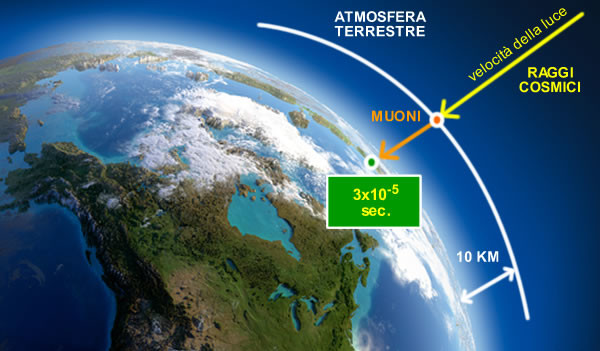
Solution to the mystery: muons hurtle at a speed very close to that of light, about 99.9 percent.
So according to the theory of relativity, for an observer on the ground, time dilates and slows down enough to extend the muon’s lifetime by many times, up to tens of ms.
In this much longer time, the muon can easily travel those few kilometers that separate it from the Earth’s surface.
Seeing a muon come to earth is a brilliant experimental confirmation of time dilation and the theory of special relativity.
Today in modern high-energy accellerators, particles are accelerated to speeds very close to those of light with powerful magnetic fields, collide and produce swarms of unstable particles that also move at very high speeds, and relativistic time dilation extends their average lifetimes by as much as ten times. For physicists working with these instruments, relativity is not an abstruse theory but daily bread.
Lorentz γ factor formula
 The dimensionless factor, dependent on the ratio v/c between the speed of the observer and the speed of light, is defined by the formula:
Approximations of Lorentz γ-factor for small velocities
If the value of is so small as to be truly negligible, compared with errors in calculation and experimental measurement, as is practically always the case in our direct experience:
For a somewhat more precise approximation, at very small but not negligible speeds
*Demonstration: *In fact, by placing in the formula for the gamma factor
becomes
and using the approximation to the curve with the tangent line in the origin that is, a linear, first-order approximation:

you get