4. The SpaceTime
“The conceptions of space and time that I wish to expound to you have arisen from the soil of experimental physics, and therein lies their strength. They are fundamental. Henceforth space per se or time per se are condemned to fade into pure shadows, and only a kind of union between the two concepts will preserve an independent reality. “Hermann Minkowski, (1908)
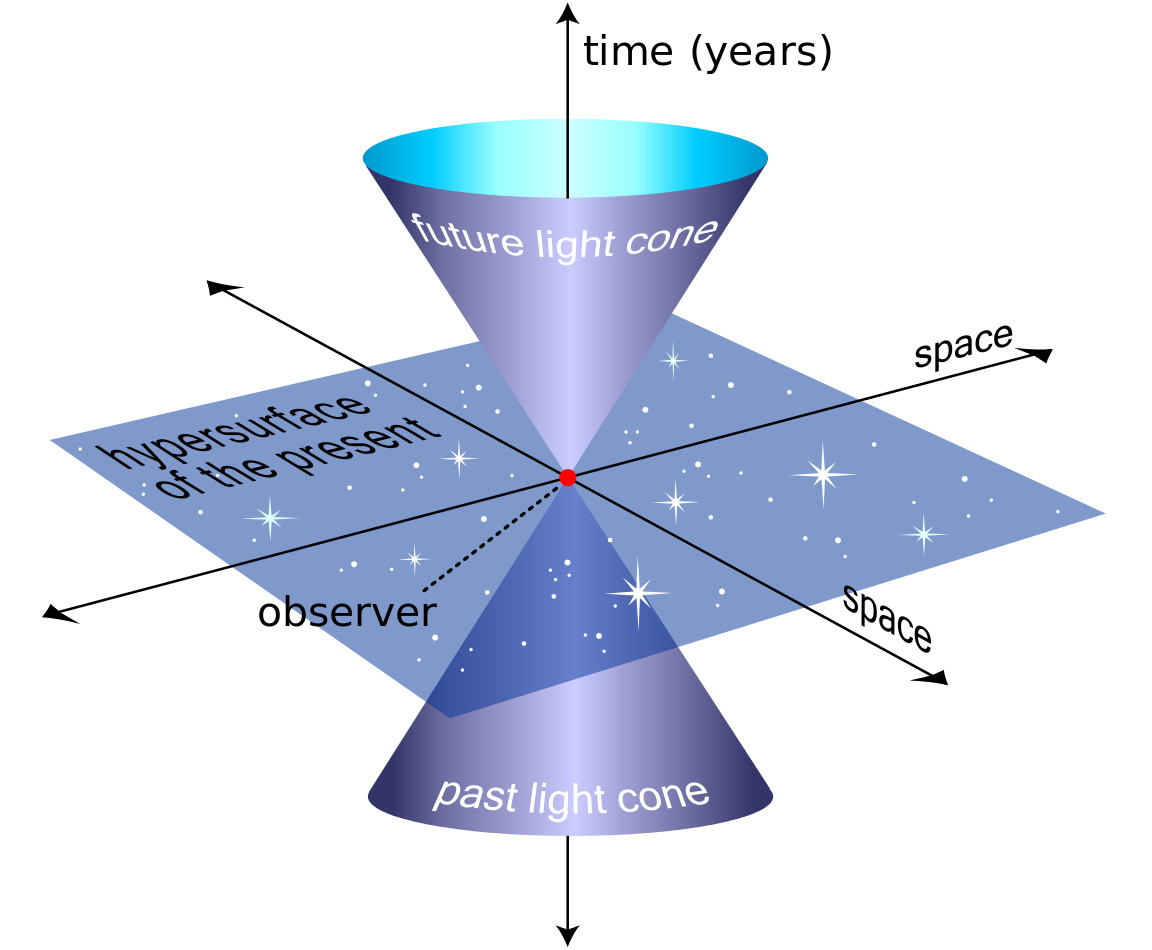
A very elegant, and not even too complicated, mathematical formalism to specify and better understand these concepts is Minkowski’s geometry of vectors in space-time, which combines space and time into a new four-dimensional space.
In the new geometry, space and time are the four coordinates of an event in four-dimensional space-time (three spatial coordinates and one temporal coordinate).
Perhaps we should focus on somewhat different physical quantities instead of space and time, if at close to the speed of light they are not independent of the observer.
We could describe a phenomenon using concepts such as:
- The separation between events in spacetime–a “global” distance between two events, the same for all, even though space and time taken separately change from observer to observer.
- The own time - the time measured by those participating in the event.
- The own space - the distance measured by those standing still from the event.
- Rest mass-the mass of a body measured in a reference system in which it is at rest
In more detail:
Separation between events in spacetime
The separation between events in space-time (also called the space-time interval) indicates the “distance “ between two events, considering both space and time. It does not change from one observer to another (in inertial systems in uniform relative motion with each other); it is invariant even though individual measures of space and time may vary. It is calculated by a formula that combines space and time, multiplied by the speed of light c, and makes it possible to tell whether two events can be connected by a light signal, a material object, or whether they are completely separate.
The distance formula describes the geometry of space In general from the formula for the separation between events all the main properties of spacetime can be derived, thelocal definition of the distance between two neighboring points in space determines the main characteristics of the geometry of that space, so it has fundamental importance.
Own time
Proper time is time measured by a clock that moves along with the object or phenomenon being observed, that is, by an observer who is “stationary” with respect to what is happening. It is the time that those who directly participate in the event “experience,” and it is always the same for all observers who move along with the phenomenon.
Own space
The space proper (or position proper) is the space measured by an observer who is standing still with respect to the object or event under consideration. For example, the length proper of an object is that measured in the reference system in which the object is at rest. This measurement is also “personal” for those standing still with respect to the object, and may change for those moving with respect to it.
Perhaps we should use the same unit of measurement for space and time, which are so closely related. So for example:
- use as for measuring time its product for the speed c of light, ct instead of t, the space in meters traveled by light in a vacuum in one second
- use as a measure of space the seconds it takes light in a vacuum to travel a certain distance, as is commonly done in astronomy for the distance of galaxies in light-years.
- use a natural unit system in which c = 1, velocities are dimensionless and range between zero and one.
Assigned a reference system, the formula for the separation of an event at the point P in spacetime with coordinates (ct,x,y,z) from the origin O of the axes (0,0,0,0) is:

classical limits and apparent paradoxes
If the ratio of the observer’s speed to the speed of light is small, Galileo’s relativity formulas and Einstein’s special relativity formulas give the same results, and even the difference in the measurement of time between two observers in relative motion is completely insignificant and negligible.
The formulas of the new relativistic dynamics give results different from the classical mechanics of Galileo and Newton only for velocities close to those of light, at least a tenth, a third or so.
In our daily experience we experience speeds that are at most a million times smaller than those of light, over a billion kilometers per hour, most of us have never traveled over 900 kilometers per hour (cruising speed of an airplane), very few at 3 thousand kilometers per hour (supersonic jets) , almost none at 30 thousand kilometers per hour (spaceship or satellite).
That is why the implications of the new theory seem strange to us compared to how we are used to thinking. Those who want to understand things based only on their direct experience will never understand anything.
So to understand the theory of relativity we need to look at examples that move at speeds very close to or equal to the speed of light. For example:
- extremely fast particles in cosmic rays or modern high-energy accelerators
- rockets, spaceships and satellites, but only if they are equipped with very precise measuring instruments, e.g., atomic clocks with accuracy greater than a nanosecond per day ( some have an error of less than a second every 15 billion years )
- stars, planets, astronomical scale phenomena and cosmology.