2. From Galileo to Einstein
“Outside was this enormous world, which exists independently of us, human beings, and stands before us as a great, eternal enigma, only partially accessible to our observation and thought. The contemplation of this world drew me as a liberation, and I immediately noticed that many of the men I had come to esteem and admire had found their inner freedom and security by devoting themselves to it. The intellectual possession of this extrapersonal world flashed before my mind, more or less consciously, as the highest goal among those granted to man…”
Albert Einstein 1
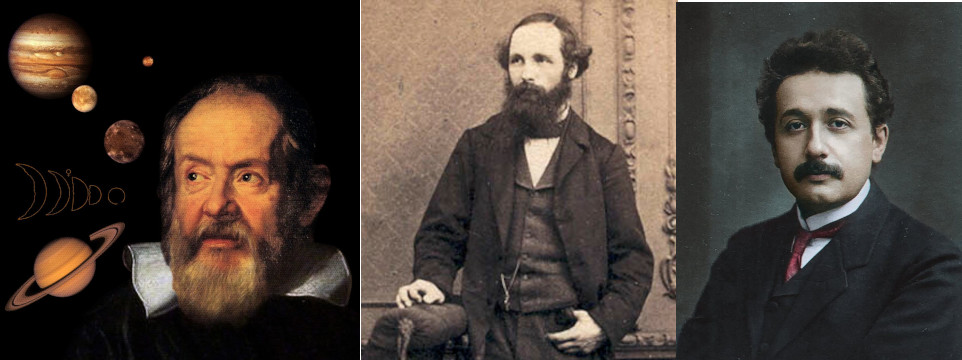
Historical evolution of theories of relativity
flowchart TD
   A0 --> B0 --> C0
   A0((Galileo Galilei - 1637)) --> A1([Le leggi del moto sono stesse per tutti gli osservatori in moto relativo uniforme])
   A1 --> A2([il moto rettilineo uniforme è indistinguibile dallo stato di quiete, l'assenza di moto ]) --> A3(Teoria della relatività di Galileo: il moto è relativo)
   B0((J.C. Maxwell - 1873 )) --> B1(Teoria unificata di elettricità, magnetismo ed ottica)
   B1 --> B2([onde elettromagnetiche: <br /> onde radio, microonde, luce visibile, infrarossi ed ultravioletti, raggi X, raggi gamma ...])
   B2 --> B3([variazioni dei campi elettrico e magnetico si  propagano nel vuoto alla stessa velocità della luce])
   C0((Albert Einstein - 1905 )) ---> C1([Le leggi del moto e dell'elettromagnetismo sono le stesse per tutti gli osservatori, in moto relativo uniforme])
   C0 --> C2([La velocità della luce nel vuoto è una costante per tutti gli osservatori ed un limite insuperabile]) --> C3
   C1 --> C3(Teoria della relatività ristretta)
   C0 --> C4([Le leggi fisiche sono le stesse per tutti gli osservatori anche in moto accelerato])
   C4 --> C5([La gravità è indistinguibile da una accelerazione del sistema di riferimento])
   C5 --> C6(Teoria della relatività generale - 1916 )
The relativity of motion
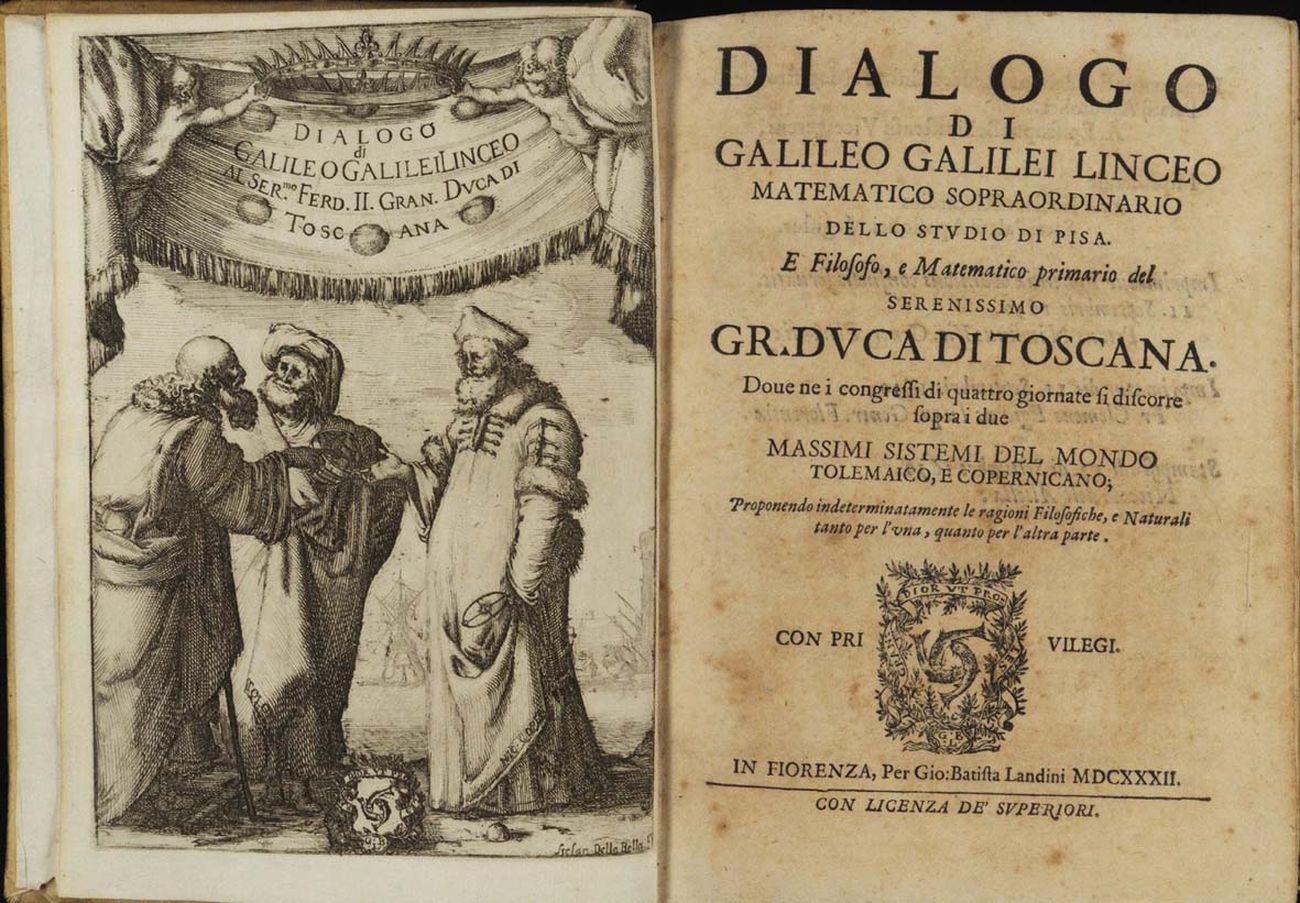
“Retain yourselves with some friends in the largest room that is under cover of any great ship, and there let there be flies, butterflies, and similar flying creatures; let there also be a large vase of water, and in it some small fish; suspend also on high some buckets, which drop by drop go pouring water into another vase of narrow mouth that is placed below; and standing still the ship, observe diligently how those flying creatures with equal speed go toward all parts of the room; the fish will be seen going noticing indifferently in all directions; the falling sprays will all enter the vessel underneath; […] Observe that you will diligently have all these things, though no doubt there is while the vessel stands still they should not so happen: make the ship move with as much velocity as you please; for (though of uniform motion and not fluctuating here and there) you will not recognize the slightest mutation in all the appointed effects; nor by any of those will you be able to understand whether the ship walks, or even stands still. “
Galileo Galilei 2
Galileo’s relativity
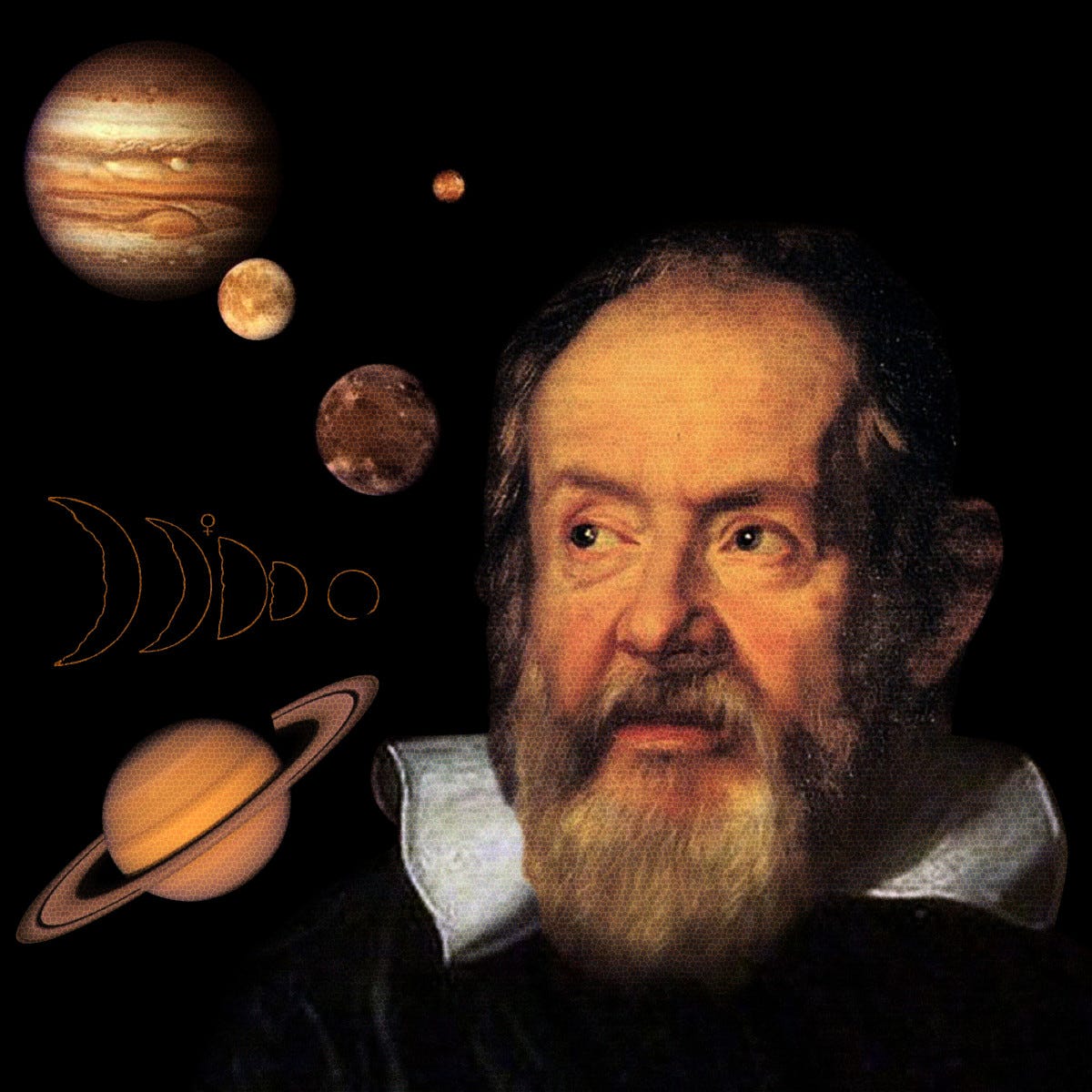
Many link relativity to Einstein’s name. But the first version is by the founder of modern science, Galileo Galilei. Galileo, besides being a great scientist, was by far the greatest Italian writer of all time, according to Italo Calvino.3 And in one of the finest pages of Italian literature, he enunciates the first formulation of the theory of relativity of motion.
Everyone who has traveled at least once by train, or ship, or bus, or airplane, knows what relativity of motion is, even without knowing anything about physics. And that one notices motion only in the presence of shocks, jolts, accelerations.
Galileo clarifies that, even the if motion is relative: the laws of motion are the same for all observers, in reference systems in relative rectilinear uniform motion, (Galileo’s principle of relativity).
Recall that:
- Uniform Motion - the motion of an object moving at a constant speed in a straight line, without acceleration, jerking or change of direction.
- Reference System - a point of view from which the motion of an object is observed; it can be stationary or integral to another moving object.
Today we know that the laws of coordinate transformation and velocity composition enunciated by Galileo are not valid for velocities close to that of light in vacuum.But in our direct experience we are dealing with velocities at least a million times smaller.
Galileo suspected that the speed of light was finite, and he tried to measure it, but with the technology of his day he had succeeded, and therefore concluded that for practical purposes it was correct to consider it infinite. Only half a century later the Dane Rømer, with astronomical measurements during eclipses of Jupiter’s moons, was able to give an estimate of the speed of light (about 225,000 km/sec, the correct value being about 299,000 km/sec).
Moreover, the mathematics available to Galileo was rather scarce; derivatives and integrals were invented by Newton and Leibniz many years later, and only with differential and integral calculus could the laws of motion be fully formulated.
Galileo’s principle of relativity was extended and refined in the early twentieth century by Albert Einstein, modifying the laws of dynamics for speeds close to, or equal to, those of light.
A move forced by the great nineteenth-century discoveries about electricity, magnetism, optics, light and radio waves, culminating in James Clerk Maxwell’s theory of electromagnetism, so special relativity was basically up in the air.
Newton’s laws of motion
“I don’t know how I may appear to the world, but to me it seems that I have been just like a boy, playing on the seashore, and amusing myself by finding now and then a smoother stone or a more beautiful shell than usual, while the great ocean of truth lies before me, completely unknown.”
Isaac Newton (Mathematical Principles of Natural Philosophy, 1686)
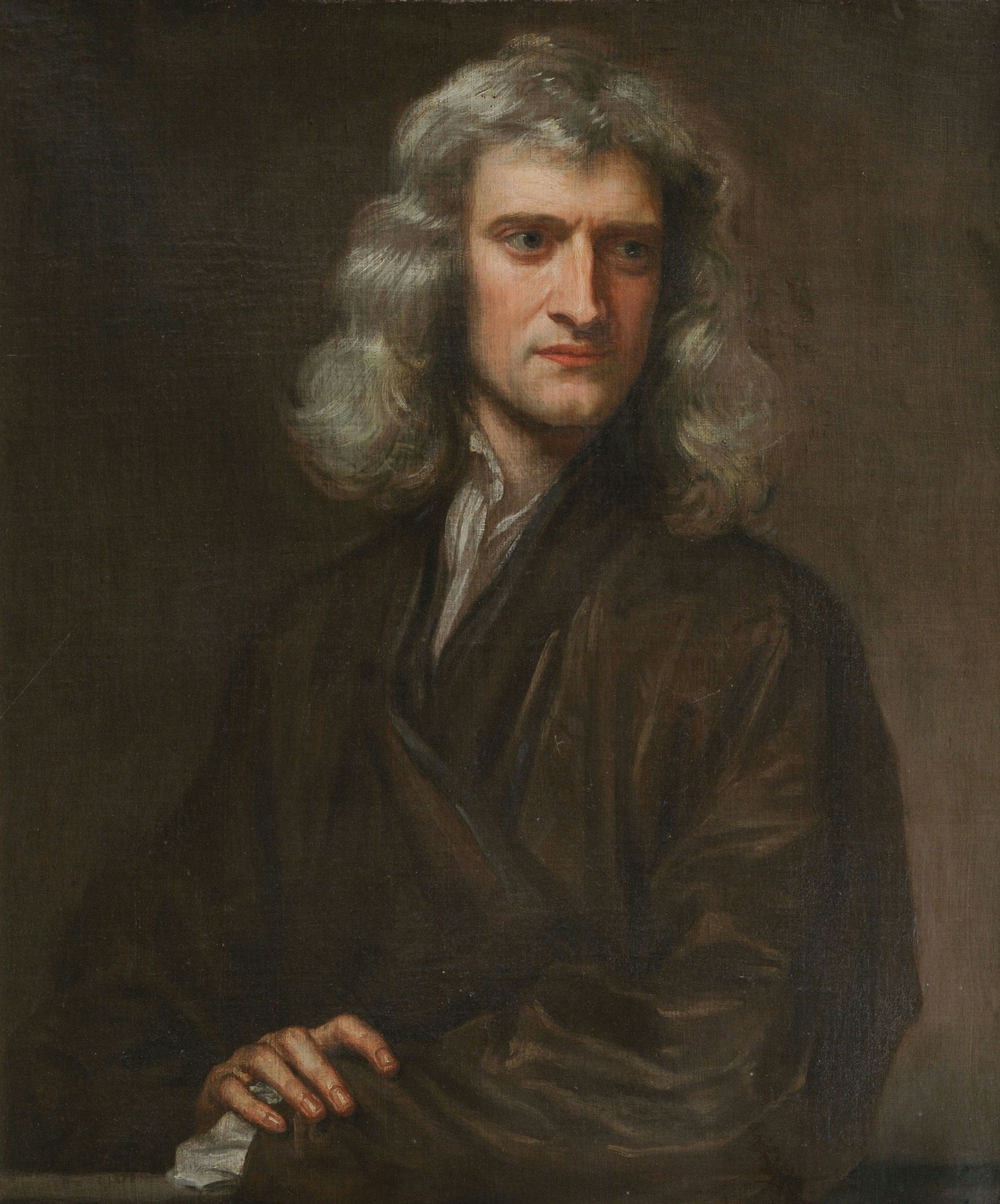
- invented the differential and integral calculus, discovered simultaneously and independently of Leibniz, the mathematical language of the dynamics of motion, and in general the language of change and its effects.
- formulates the three basic laws of motion, which describe the behavior of objects in motion: law of inertia, law of force as the product of mass and acceleration, and law of action and reaction (the first two were already guessed by Galileo)
- develops the theory of universal gravitation, which explains how the force of gravity acts among all objects in the universe, unifying the motion of celestial bodies and the motion of terrestrial objects, Kepler’s discoveries and those of Galileo (first great unification of physics).
The electromagnetism revolution
Maxwell’s theory of electromagnetism explains how electrical and magnetic phenomena work, and the propagation of electromagnetic waves, such as radio waves, microwaves, infrared, visible light, and X-rays:
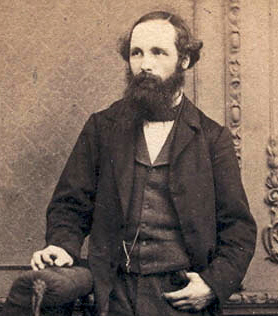
- Electric charges generate electric fields. Charges in motion (electric currents) generate magnetic fields. A changing electric field generates a magnetic field and vice versa.
- Electromagnetic waves, like visible light, are formed when an electric and magnetic field vary in time and space, and propagate in empty space at the speed c = 299,792,458 m/s , about 300 thousand km/sec, over a billion km/h (~ 1.08 x 10⁹ km/h) .
- The speed of light c 4 ) is constant and independent of the motion of the source or observer.
- The theory of electromagnetism, along with quantum physics and statistical physics, underlies all modern technology, from radio communications to radar to cell phones.
From electromagnetism to special relativity.
Maxwell’s theory of electromagnetism, with the constancy of the speed c of light in a vacuum, runs counter to Newton’s laws of motion. The law of composition (sum) of velocities no longer applies, because the speed of light does not vary for observers in relative motion with each other.
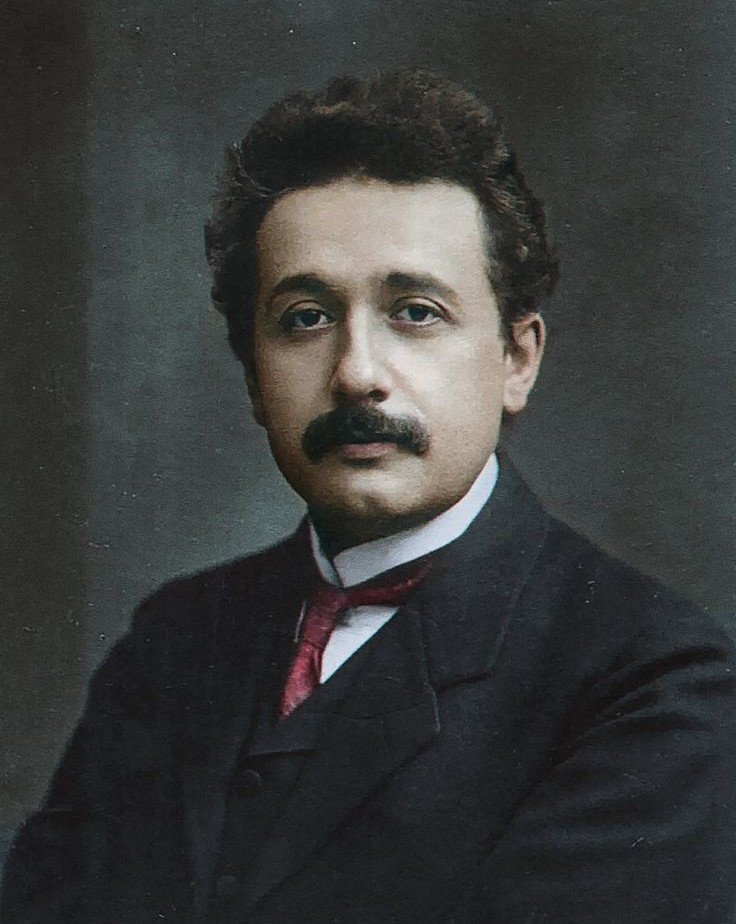
Moreover, the equations are not invariant for the coordinate transformations of Galileo’s relativity. But they are invariant to different formulas for coordinate transformations between reference systems in uniform relative motion, known as Lorentz transformations (from the Dutch theoretical physicist who discovered them).
Einstein, in the theory of restricted (or special) relativity, extends Galileo’s principle of relativity from the laws of motion to the laws of electricity and magnetism as well:
- The laws of physics are the same, in all reference systems, for all observers in uniform rectilinear motion with each other, and do not change shape for a coordinate transformation.
- the speed of light in vacuum c is constant for all observers in uniform relative motion with each other
The second principle was later replaced by the condition that the valid coordinate transformations between reference systems are those that leave the equations of electromagnetism unchanged, the Lorentz transformations . From the Lorentz transformations the second principle, constancy of the speed of light, follows easily.
As is also evident by examining the propagation equation for electromagnetic waves, in which the speed of light c appears explicitly. So it must be a constant, otherwise the equation would not be invariant between different reference systems.
The contradictions between the theory of electromagnetism and that of classical mechanics were by 1905, the year Einstein published his work, so much so that parts of his theory had been anticipated by other theoretical physicists, such as Lorentz, Poincarè, Larmor, and Fitzgerald.
And other parts of the theory were refined shortly thereafter by mathematical physicists such as Minkowski.
Curiosity:
In the ranking of the greatest physicists of all time by Physics World December 1999, we find Einstein, Newton, Maxwell, Galileo in first, second, third and sixth place respectively ( fourth and fifth are Bohr and Heisenberg, followed by Feynman, Dirac and Schrodinger).
Note: Calvin’s article is quoted in Pietro Greco, “Galileo, according to Calvin,” Science on the Net, 2009, https://www.scienzainrete.it/galileo-secondo-calvino among Italian writers in second place was political scientist Niccolò Macchiavelli, in third place perhaps engineer Carlo Emilio Gadda and chemist Primo Levi, unaccomplished literati (we are obviously not talking about poets, among whom is a certain Dante).
A.Einstein, “Autobiografia scientifica” (1949) ↩︎
G. Galilei, “Dialogo sopra i massimi sistemi del mondo”, 1637 ↩︎
Italo Calvino, “Risposta ad una lettera aperta di Anna Maria Ortese”, Corriere della Sera, 24 dicembre 1967 ↩︎
Il simbolo c per la velocità della luce viene dal latino, celeritas, velocità ↩︎