Condensed Matter
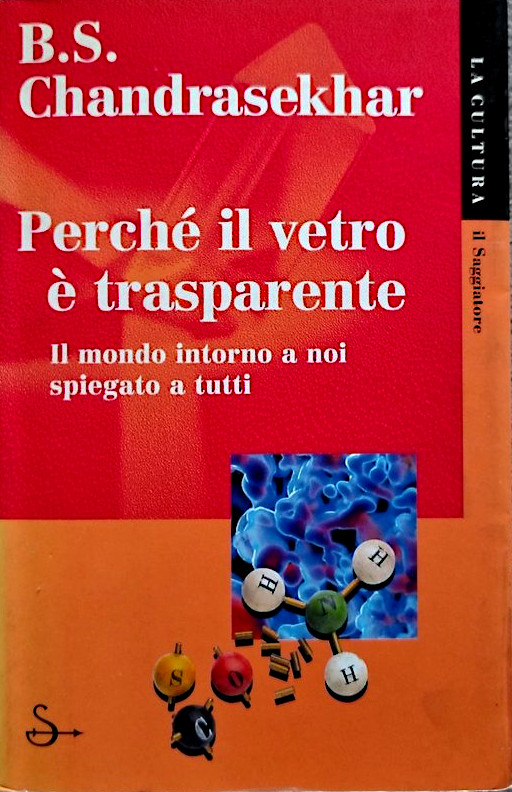

- Bellur S. Chandraseckhar - Why glass is transparent.The world around us explained to everyone - (2001)
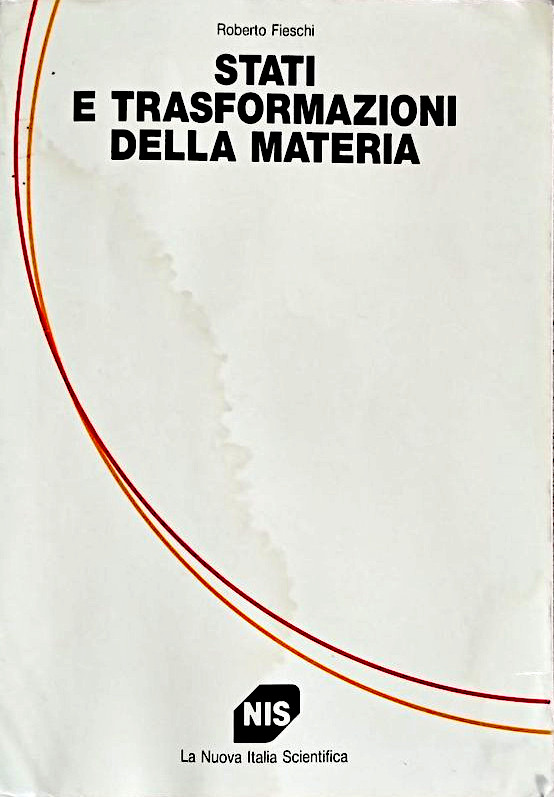
- Roberto Fieschi - States and Transformations of Matter - (1993)
- Giorgio Careri - Order and disorder in matter - (1982)
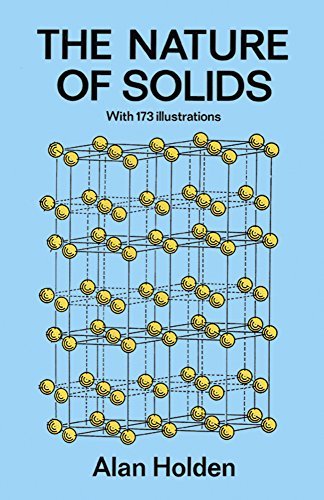
- Alan Holden - The nature of solids - (1992)
- Ho-Kim Quang, Narendra Kumar, Harry Chi-Sing Lam - Invitation To Contemporary Physics - 2nd ed. (2004)
- Adrian P. Sutton - Concepts of Materials Science - (2021)
In the Very Short Introduction series of Oxford University Press:
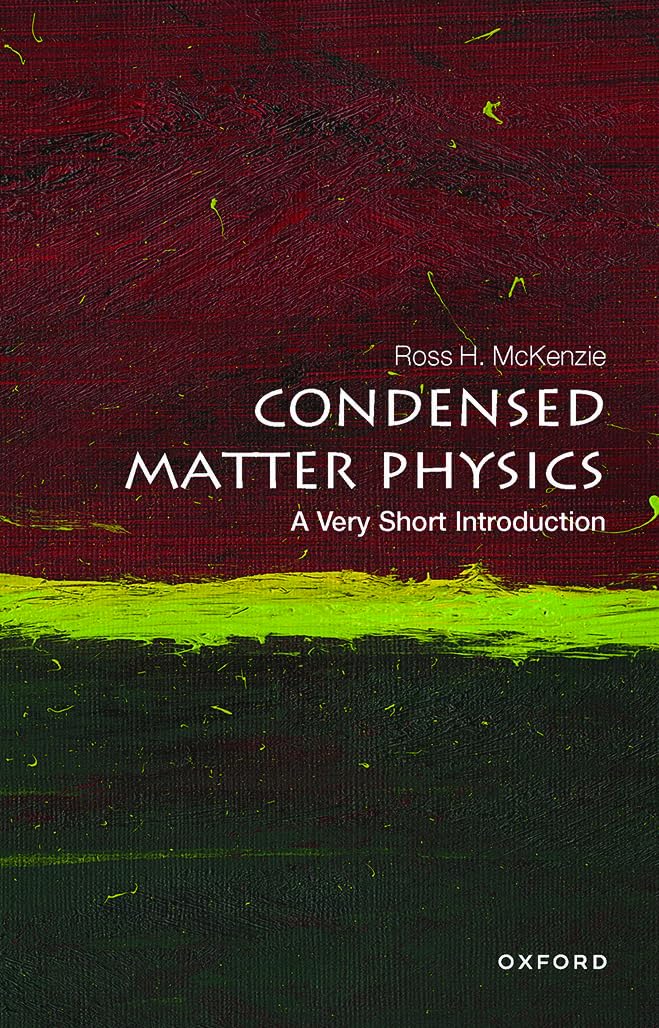
- Ross H. McKenzie - Condensed Matter Physics - (2023)
- Tom McLeish - Soft Matter - (2020)
- A.M. Glazer - Crystallography - (2016)
- Stephen J. Blundell - Magnetism - (2012)
- Stephen J. Blundell - Superconductivity - (2009)
of which only has been translated into Italian:
- Stephen J. Blundell - Superconductivity - (2012)
For the relationship between science, politics, finance and society in the postwar United States is indispensable:
- Joseph D. Martin - Solid State Insurrection: How the Science of Substance Made American Physics Matter - (2019)
A separate post deserves:
- David J. Goodstein - States of Matter - new ed. (2014)
Bellur Sivariamiah Chandraseckhar - Why the things are the way they are.
transl.it. Why glass is transparent. The world around us explained to everyone - (2001)
So many popular books focus on applications in atomic and subatomic physics, or on the history and philosophy of quantum mechanics. But the most important aspect of the quantum mechanics revolution are the applications to the chemistry and structure of matter, to the physics of condensed states: solids, liquids, gels and polymers, semiconductors, superconductors, lasers. This rare and beautiful example of popularization by a solid-state physicist is a non-technical exposition but one that does not oversimplify, and does not trivialize the subject matter. A better answer to what quantum mechanics is and what it is for than that of particle physicists such as Kenneth W. Ford (The Quantum World. Quantum Physics for Everyone) or Leon Lederman and Chris Hill (Quantum Physics for Poets).
“Why Glass is Transparent” shows how, through the laws of physics and in particular through the principles of quantum mechanics, it is possible to understand why objects that surround us in our everyday lives behave in a certain way or exhibit certain characteristics. The author explains that the properties of various materials depend on the structure of the atoms that compose them. Thus, it is possible to understand why metal conducts heat better than plastic, why certain substances, when subjected to a given pressure, bend while others break, why certain materials possess a specific color, such as ruby, while others, such as glass are more or less transparent.
Topics include: Crystals.Particles and waves.The atom.Statistical physics.The quantum crystal.Copper wires and glass rods.Silver spoons and plastic spoons.Glass plates and aluminum foil. Electric bulbs and insulated wires.Magnets.Superconductors.
Roberto Fieschi - States and transformations of matter - (1993)
Il mondo inanimato si presenta ai nostri occhi con grande ricchezza di forme e di proprietà. Fin dalle origini del pensiero filosofico e scientifico l’uomo si è posto il problema di interpretarne la molteplicità, riconducendo la varietà dei fenomeni osservati ad alcuni principi fondamentali. Da oltre due millenni, dunque, si è avviata la ricerca dei ‘mattoni’ che costituiscono il mondo fisico così come esso ci appare e delle leggi fondamentali per il cui tramite essi interagiscono, in modo da poter interpretare l’architettura della materia nei suoi tre stati di aggregazione e le sue trasformazioni dall’uno all’altro. Qui si tenta di dare una visione complessiva dei fenomeni più significativi relativi all’immenso settore della fisica che va sotto il titolo generale di struttura della materia, e di inquadrare le proprietà macroscopiche entro gli schemi della fisica contemporanea. Dedicato non solo ai tecnici, ma anche agli studenti di liceo e, come lettura preliminare a corsi specifici, agli studenti un
Table of Contents:
- Foreword
- the states of aggregation of matter 1
- introduction 1.1
- 1.2 The states of aggregation
- 1.3 State changes
- overview of thermodynamics 2
- 2.1 Generalities
- temperature and zeroth principle 2.2
- 2.3 Amount of heat
- 2.4 The first principle
- 2.5 The second and third principles
- equations of state 2.6
- 2.7 Ideal systems
- macroscopic properties 3
- the ideal gas The equation of state / Internal energy / Other characteristics of the ideal gas 3.1
- real gases Equations of state/internal energy The Joule-Kelvin (or Joule-Thomson) effect 3.2
- 3.3 Liquids General characteristics / The saturated vapor pressure / The critical temperature / Water
- liquid solutions 3.4
- liquid helium, superfluidity 3.5
- 3.6 The solids Historical development outline
- 3.7 Physical properties of solids Mechanical properties / Optical properties / Thermal properties / Electrical properties / Magnetic properties / Superconductivity / Ferroelectricity
- 3.8 The amorphous solids
- liquid crystals 3.9
- 3.10. Plasma
- the microscopic structure of matter 4
- 4.1 Introduction The building blocks / Laws
- 4.2 The architecture Some models / It is built on a solid foundation
- 4.3 Ideal solids Electronic properties.Band theory / Insulators / Semiconductors / Metals / Ferromagnetic properties / Lattice dynamics.One-dimensional model
- 4.4 Real solids Lattice imperfections Vacancies / Other point imperfections / Linear imperfections Dislocations
- phase transitions 5
- 5.1 Generalities
- first-order transitions 5.2
- 5.3 The critical phenomena
- Bibliography Tabs
- Analytical Index
Giorgio Careri - Order and disorder in matter - (1982)

three lectures on interdisciplinary aspects : (Rome, November 26, 28 and 30, 1979)
Stephen J. Blundell - Superconductivity - (2012)
Superconductivity, a particular state of certain materials in which electric current flows without resistance, is one of the great revelations, both mysterious and fascinating, of twentieth-century physics. In this volume, Stephen Blundell explains how studies of superconductivity have influenced other areas of science, from the search for the now “mythical” Higgs boson to investigations into the early universe. The author also examines the many strange phenomena observed in superconducting materials, the latest developments in scientific research, and its potential to revolutionize physics and technology in the future. Indeed, the applications of superconductivity are the most diverse and curious: from magnetic resonance technology to Japanese magnetic levitation trains to the flying skateboard in the second episode of Back to the Future.
Superconductivity is much more than a physical phenomenon. It could be one of the fundamental elements of a new technology, and ultimately of a new look at reality. “Astronomy”
Although the name given by Onnes preceded Superman by more than a decade, the spirit was much the same: just as the comic book hero could defeat gravity in a way no man could, the superconductor could defeat the laws of electricity in a way no other material known until then had been able to do. Stephen Blundell
Ross H. McKenzie - Condensed Matter Physics - (2023)
There are many other states of matter besides solid, liquid, and gaseous. Some examples include liquid crystals, magnets, glass, and superconductors. New states are being discovered all the time and unexpectedly. Some states, such as the superconductor, can behave like Schrödinger’s cat and exhibit the oddities normally associated with the quantum theory of atoms, photons, and electrons. Condensed matter physics seeks to understand how states of matter and their distinct physical properties emerge from the atoms of which a material is composed.
A system of many interacting parts can have properties that the parts do not have.Water is wet, but a single water molecule is not.Your brain is conscious, but a single neuron is not.These emergent phenomena are central to condensed matter physics and also occur in many fields, from biology to computer science to sociology, giving rise to rich intellectual connections.When do quantitative differences become qualitative differences? Can simple models describe rich and complex behavior? What is the relationship between the particular and the universal? What is the relationship between the abstract and the concrete? Condensed matter physics deals with these big questions.
The materials of silicon chips, liquid crystal displays and magnetic memories in computers may have transformed society, but their understanding has transformed the way we think about complex systems.
Ross H. McKenzie is professor emeritus of physics at the University of Queensland, Brisbane, Australia. His research in condensed matter physics focuses on using quantum theory to understand complex materials, from organic superconductors to fluorescent proteins. He has lectured on this topic to schools and the public, as well as running a blog, Condensed Concepts, which was published in an issue of Physics World.
Alan Holden - The nature of solids - (1992)
“This excellent book by a distinguished author presents a non-mathematical account of current theories of solid-state physics…Holden’s lucid writing style fits the needs of his audience perfectly; students will find it a pleasure to read.”- Choice Unusually clear and accessible, this well-received volume provides a non-technical, non-mathematical introduction to the fundamentals of solid-state physics. It can be read by any student with a background in physics or chemistry in high school and will be useful to scientists and engineers as an introduction to the field of solid-state theory. La prima metà del libro sviluppa i concetti di base della fisica atomica moderna. Include discussioni illuminanti su calore, capacità termica, ordine, simmetria, atomi e ioni, molecole, metalli e strutture. La seconda parte applica poi i concetti chiariti alle proprietà strutturali ed elettriche dei materiali solidi. Questo include la trattazione dei moti atomici, delle particelle e delle onde, degli elettroni negli atomi, degli elettroni nei solidi, della conduzione elettrica, dei semiconduttori e dei magneti. Un’appendice intitolata “Scale di Energia” completa il libro. Il Dr. Holden, ex ricercatore presso i Bell Telephone Laboratories ed ex professore ospite al MIT, non approfondisce l’interazione tra teoria ed esperimento. Piuttosto, queste pagine sono dedicate, nelle sue parole, a “spiegare le teorie – a rappresentare i modelli – che forniscono il mezzo migliore oggi conosciuto per unificare la nostra conoscenza dei solidi e collegarla a un campo più ampio della scienza”. I lettori scopriranno ch
Adrian P. Sutton - Concepts of Materials Science - (2021)
All technologies depend on the availability of suitable materials. The progress of civilization is often measured by the materials used by humans, from the Stone Age to the Silicon Age. Engineers exploit the relationships between a material’s structure, properties, and production methods to optimize its design and production for specific applications. Scientists seek to understand and predict these relationships.
This short book lays out the fundamental concepts that underlie materials science and emphasizes their relevance to mainstream chemistry, physics and biology. These include the thermodynamic stability of materials in various environments, the quantum behavior that governs all matter and active matter. Others include defects as agents of change in crystalline materials, nanoscale materials, the emergence of new science at increasing length scales in materials, and man-made materials whose properties are determined by their structure rather than their chemical composition.
The book offers a unique insight into the essence of materials science at a level suitable for pre-college and undergraduate students of materials science. It will also be suitable for graduates of other disciplines who intend to pursue postgraduate studies in materials science. Professional materials scientists will also find it stimulating and occasionally provocative.
Author: Adrian P. Sutton FRS, Professor Emeritus, Faculty of Natural Sciences, Department of Physics, Imperial College London
Educated at the Universities of Oxford and Pennsylvania, Adrian Sutton has studied materials for 48 years, publishing 230 papers and five books. At the University of Oxford, he has taught all bachelor’s degree programs. His research is in materials theory and simulation (TSM) and he is a founding member of the Thomas Young Centre, the London-based Center for TSM. In 2009, he founded the renowned Doctoral Training Center on TSM at Imperial College. In 2012, he was awarded the Chancellor’s Medal for Outstanding Innovation in Teaching at Imperial College, and in 2018 he became Professor Emeritus in the Department of Physics at Imperial College. He is a Fellow of the Royal Society.
Joseph D. Martin - Solid State Insurrection: How the Science of Substance Made American Physics Matter - (2019)
Solid-state physics, the study of the physical properties of solid matter, was the most flourishing subfield of Cold War American physics. Despite prolific contributions to consumer and medical technology, such as the transistor and magnetic resonance imaging, it garnered less professional prestige and public attention than nuclear and particle physics.
Solid State Insurrection argues that solid-state physics was essential in securing the vast social, political and financial capital that Cold War physics enjoyed in the 20th century. Solid State’s technological vocation, and its challenge to the ideal of “pure science” cherished by many physicists, helped physics as a whole respond more readily to the social, political and economic pressures of the Cold War. Its research kept physics economically and technologically relevant, sustaining its cultural standing and political influence long after the splendor of the Manhattan Project had worn off. With this book, Joseph D. Martin offers a new perspective to some of the most unresolved questions about the role of physics in American history.
What is solid state physics? This seemingly simple question has some equally simple answers: solid state physics is the study of the physical properties of solid matter; it is a subfield of physics, the most populous in the United States for much of the second half of the 20th century; it is the branch of condensed matter physics that studies solids with regular crystalline structures. These answers are true in their respective domains, but they omit a number of complex details. Research on the properties of solids has a long history, but it was not until the mid-20th century that physical research on solids became the focus of a new discipline. Yes, the physicists who founded solid state physics and integrated it into the larger segment of the American physics community were primarily interested in understanding the behavior of regular solids, but this sheds only a pale light on those factors that make the field worthy of historical attention. The fi
Solid State Insurrection, published by the University of Pittsburgh Press (2018), tells the story of how solid state physics challenged and redefined some of the fundamental ideals of American physics, and in the process played an essential role in sustaining the prestige physics enjoyed in Cold War American society.
- David J. Goodstein - States of Matter - new ed. (2014)
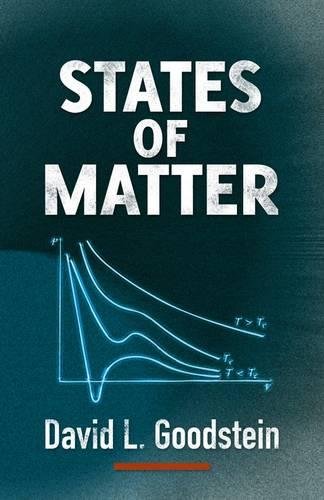
This unique overview, edited by an eminent CalTech physicist, offers a modern, rigorous, and integrated treatment of key physical principles and techniques relating to gases, liquids, solids, and their phase transitions. No other volume offers such comprehensive coverage of the subject, and the treatment consistently emphasizes areas where research findings are likely to be applicable to other disciplines. Beginning with a chapter on thermodynamics and statistical mechanics, the text proceeds with in-depth discussions of perfect gases, electrons in metals, Bose condensation, fluid structure, potential energy, Weiss molecular field theory, van der Waals equation, and other pertinent aspects of phase transitions. Many useful illustrative problems are provided at the end of each chapter, and annotated bibliographies offer further guidance.
David L. Goodstein is Professor of Physics and Applied Physics at the California Institute of Technology, where he was named Frank J. Gilloon Distinguished Teaching and Service Professor in 1995. His other books include The Lost Lesson of Feynman and On Facts and Frauds: cautionary tales from the front lines of science.