Space, Time Quanta - Mills
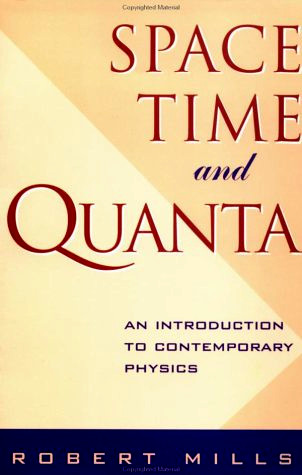
- Robert Mills - SPACE, TIME AND QUANTA. An introduction to contemporary physics - 1st ed. 1994
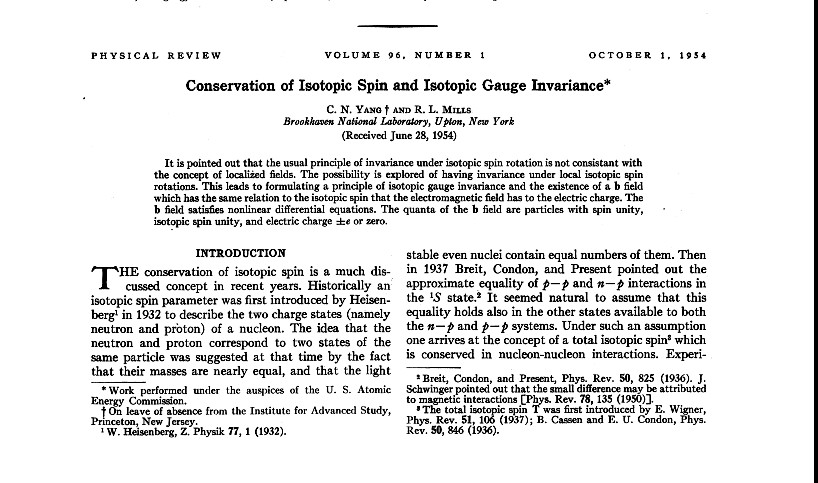
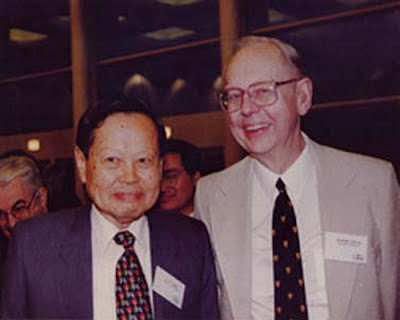
The fortunate turning point in Robert Lawrence Mills’ life came in 1954 at age 27, when he was finishing his PhD in theoretical physics at Columbia University in New York. Having obtained a small place to finish his thesis at Brookhaven National Lab, Long Island, they put him in a small room with two desks along with a young 32-year-old Chinese man, a former student and favorite assistant of Enrico Fermi in Chicago, Chen-Ning Yang. Immediately the two plunged into working together on the possibility of extending to interactions between elementary particles a property of Maxwell’s equations, and of QED, known as local “gauge” invariance, first proposed 40 years earlier by the brilliant German mathematical physicist Hermann Weyl (see, e.g., “Space Time Matter”). A few months later (October) the article by Yang and Mills came out in Physical Review in which they proposed quantum field theories with noncommutative gauge invariance (in which the outcome depends on the order of the symmetry transformations), one of the main building blocks of the standard model of elementary particles, fundamental interactions, and modern high-energy physics. Three years later Yang flew to Stockholm to receive the Nobel Prize in Physics for the discovery of non-conservation of parity in weak interactions (more or less in simple words, “the microscopic world is different when reflected through a mirror”), proposed in collaboration with compatriot Tsung Dao Lee, and immediately verified in the spectacular experiment of Chien-shiung Wu (“Madame Wu”), also from China.
Many years later, in the late 1980s, Prof. Mills, emeritus of theoretical physics at The Ohio State University, accepted another challenge, an educational experiment. Explaining modern physics to people who had never before taken a real physics course: college freshmen, recent high school graduates. The basic idea was that young people who were motivated and fascinated by seeing the most advanced discoveries in the most rapidly advancing fields would enroll in science faculties en masse, and become more enthusiastically engaged in the traditional courses of the early years (general physics, mechanics, thermodynamics, electromagnetism, waves,…) after seeing where they could go to the frontiers of research. Mills divided the first semester course into three mini-courses: i. Relativity (special and general, with a sprinkling of classical and statistical physics) iI. Quantum Mechanics iII. Particles and Force Fields The scientist prepared the material assuming that the students knew high school math (algebra, analytic geometry, trigonometry,..) well enough, a little derivatives and integrals, but nothing more. In fact, he included a quick review of all the necessary prerequisites. The first two short courses are revised and published in this volume. For the third one you could once ask for the dispensations directly from the author, and they are going around the Internet but I have not yet been able to find them. As already mentioned it is a book divided into two parts:
Part I SPACE AND TIME
- Is the earth standing still?
- Clocks, meters and the universal speed limit
- Moving around in spacetime
- Dynamics, impulse and force
- Energy
- Gravity and curvature of spacetime
- The shape of the Universe
- The direction of time?
- Thermodynamics
Part II QUANTISTIC PHYSICS 10. The strange behavior of waves and particles 11. The waves 12. The atom with only one electron (hydrogen) 13. Historical principles (correspondence, uncertainty, complementarity, overlap) 14. Schrodinger’s wave equation 15. The role of the observer 16. Photons
APPENDICES
- A. Math Notes: Trigonometry, vectors, analytic geometry, derivatives, integrals, approximations, complex numbers.
- B. Newton’s mechanics
- C. Miscellaneous information: Greek alphabet, units of measurement, physical constants, astronomical data.

At this level there is very little available in the library or bookstore: clear, authoritative, profound and accessible even to non-specialists, to those who have not taken undergraduate courses in physics. For relativity e.g., Taylor and Wheeler’s two volumes (“Spacetime physics,” “Exploring Blackholes”), George Ellis’s (“Flat and curved spacetimes”). For Quantum Mechanics a comparable level introduction is that contained in the final part of Shankar’s “Fundamentals of Physics II,” but it assumes the reader has studied the entire general physics course. As does Feynman’s introduction in vol. III of “Feynman’s Lectures on Physics.” A different and complementary introduction, is that of Susskind in the second volume “Quantum Mechanics” of the “Theoretical Minimum” series, which focuses more on qubits and matrices than on the wave function as Mills. On a more popularized level, but not even that much, there are Sean Carroll’s two beautiful volumes of the “Biggest Idea in the Universe” series. The new volume is quite expensive, and maybe even out of print; you can check it out at the library, pick it up bargain among the unsold items at the bookstore, the online used offerings (the route I took).