Flat & Curved SpaceTimes - Ellis
- George F.R. Ellis, Ruth M. Williams - FLAT AND CURVED SPACE-TIMES - 2nd ed. Oxford (2001)
Several important holidays fall on March 14:
- March 14 (3/14 in Anglo-Saxon countries) is International Pi Greco Day , on which we have already given.
- On March 14, 1879, a genius, Albert Einstein, was born in Ulm, Baden-Württemberg
- On March 14, 1988 near Sacramento, California, was born Marina-Ann Hantzis, better known to the world as Sasha Grey, not a genius but certainly a very intelligent woman.
- On March 14, 2018, a genius, Stephen Hawking, died in Cambridge, England
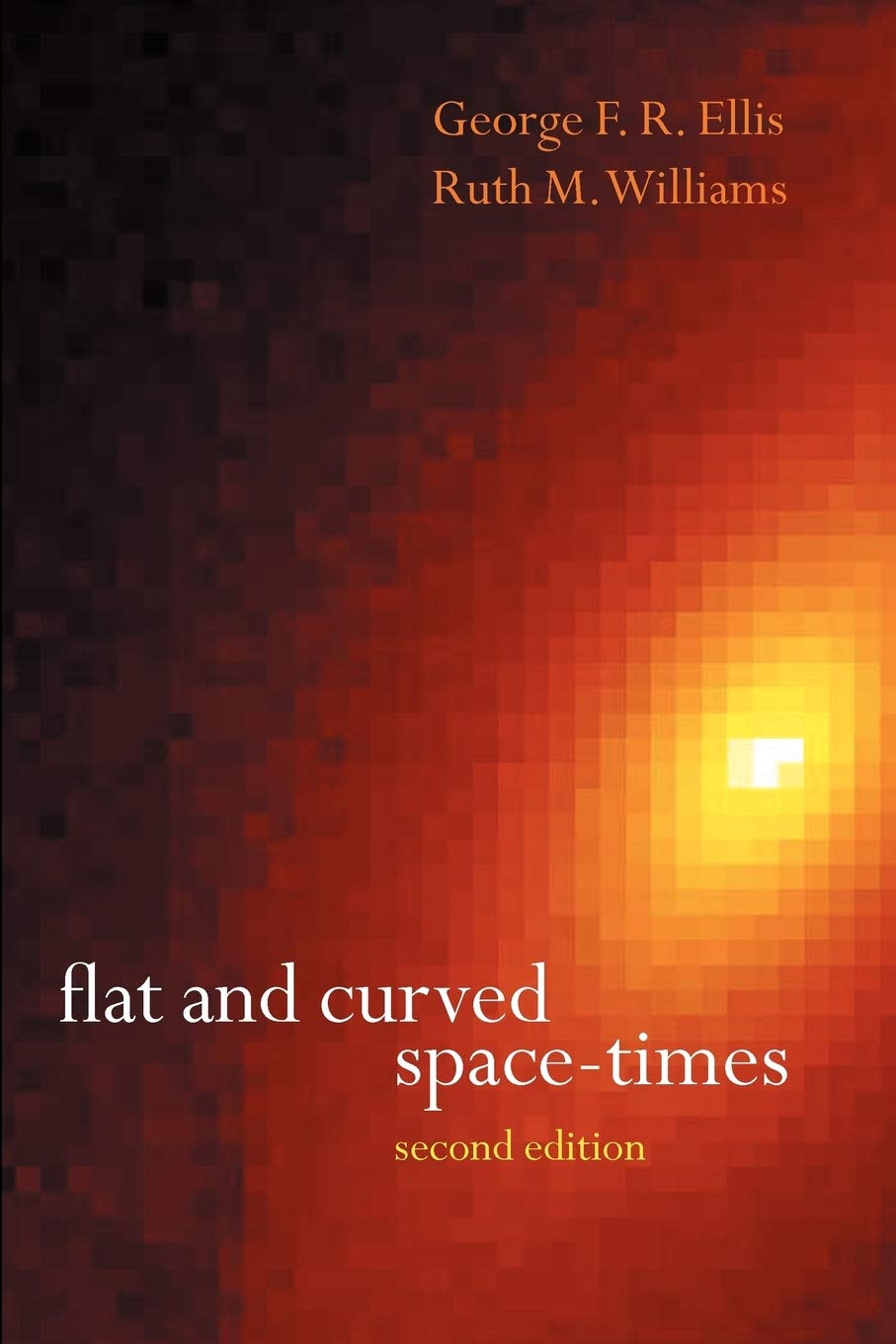
To celebrate (2) and (4) instead, we can take back in one hand a great book, by George Ellis.
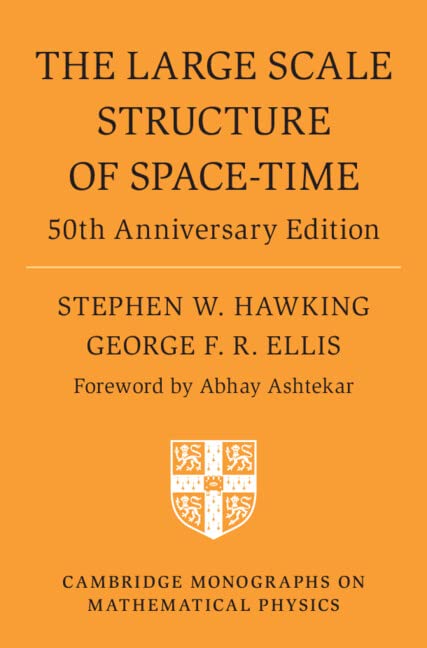
The most important applications of Einstein’s theory of general relativity are in the fields of astrophysics and cosmology. On the implications of Einstein’s equations for our knowledge of space-time a fundamental work is: “The Large Scale Structure of Space-Time” The Large Scale Structure of Space-Time, written by four hands precisely by Stephen Hawking and George Ellis.
A special 50th anniversary edition has been in the bookstores for a few days now, with a new preface by Ellis and a new appendix by Abhay Ashketar. But it is not a book for everyone; in fact, it is readable only by the few who have advanced and deep knowledge of theoretical physics, mathematical physics, differential geometry, topology, nonlinear equations to partial derivatives, and so on.
In contrast, “Flat and Curved Space-Time,” by Ellis with the collaboration of Ruth Williams, is a book without too much mathematics, and moreover the more complicated mathematics is confined all in the appendices. So it is accessible to all students of science, even secondary school (high school) students, and to the interested and sufficiently motivated reader.
In contrast to so many supposedly popularized books of great success in bookstores (no need to name names, especially those who are no longer around,..) it tries to really explain the curvature of space-time, relativistic effects, black holes, to non-specialists of the subject. And to talk about cosmology without lapsing into fairy tale fiction and fantasy fiction. It succeeds very well, and also provides a solid foundation for further study of the subject in more advanced texts, such as college textbooks. At this level there are perhaps only the volumes of Edwin Taylor and John Wheeler (“Space-time Physics,” translated as “Space-time Physics,” “Exploring Black Holes”), also available free online, French’s classic textbook (“Special Relativity”), Mills (“Space Time and Quanta”). The title indicates that both special (flat space-time) and general (curved space-time) relativity are covered.
The exposition is divided into 8 chapters:
- Space-time diagrams and fundamentals of special relativity
- Measurement elements
- Measurements in flat space-time
- Lorentz transformations and the invariant interval
- Curved space-time
- Stellar and spherical collapse
- Simple cosmological models
- Final considerations From Ch. 3, Bondi’s K-calculus is introduced to simply calculate relativistic effects. Ch. 5 discusses gravitational waves and methods for detecting them. Ch. 6 explains Schwarzschild’s solution, black holes, and the thermodynamics of their evaporation. In ch.7 the various models of the universe (stationary, inflationary,…) For 95 percent of the book, high school algebra and analytical geometry are sufficient and advanced, with an intuitive idea of velocity, acceleration and infinitesimal interval in space-time. And there are plenty of illustrations and diagrams to better explain the concepts. The appendices explain in a simple way the advanced mathematical concepts needed to consult the college-level texts cited in the bibliography: quadrivectors, tensors, line integrals, the electromagnetic field tensor and the energy-impulse tensor of matter. The book, of about 380 pages, is quite expensive as a list price. Check it out at the library or buy it second-hand.

George Francis Rayner Ellis (1939) is a South African theoretical physicist and professor emeritus of Complex Systems in the Department of Mathematics and Applied Mathematics at the University of Cape Town. In the 1970s and 1980s, during South Africa’s segregationist government, Ellis was an open opponent of apartheid policies. For this, too, Nelson Mandela personally awarded him South Africa’s highest honor, the Grand Cross of the Order of the Star of South Africa, in 1999. In 2007 he was elected a Fellow of the Royal Society. Considered one of the world’s leading cosmologists, he published in 1973, together with Stephen Hawking, the famous monograph “The Large Scale Structure of Space-Time.” The first part of his career is at the University of Cambridge (PhD, research fellow, associate) to return to the Univ. of Cape Town as full professor. George Ellis has worked for many decades on anisotropic cosmologies (White models) and inhomogeneous universes, and on the philosophy of cosmology. In recent times he has worked on the emergence of complexity and how this is made possible by causality in the hierarchy of complexity of systems. He has also collaborated with Teppo Felin, Denis Noble and Jan Koenderink on a series of papers published in the journal Genome Biology. In terms of philosophy of science, Ellis is a Platonist.

Ruth Margaret Williams is a mathematician at DAMTP, Cambridge, has worked mainly on general relativity, discrete quantum gravity with Regge calculus, in which space-time is approximated by successions of flat simplexes forming 4-dimensional geodesic domes. The formalism used by Williams was invented by Italian theoretical physicist Tullio Regge in 1961.