Fly by night Physics - Zee
- Anthony Zee - FLY BY NIGHT PHYSICS: How Physicists Use the Backs of Envelopes, Princeton University Press, 2020
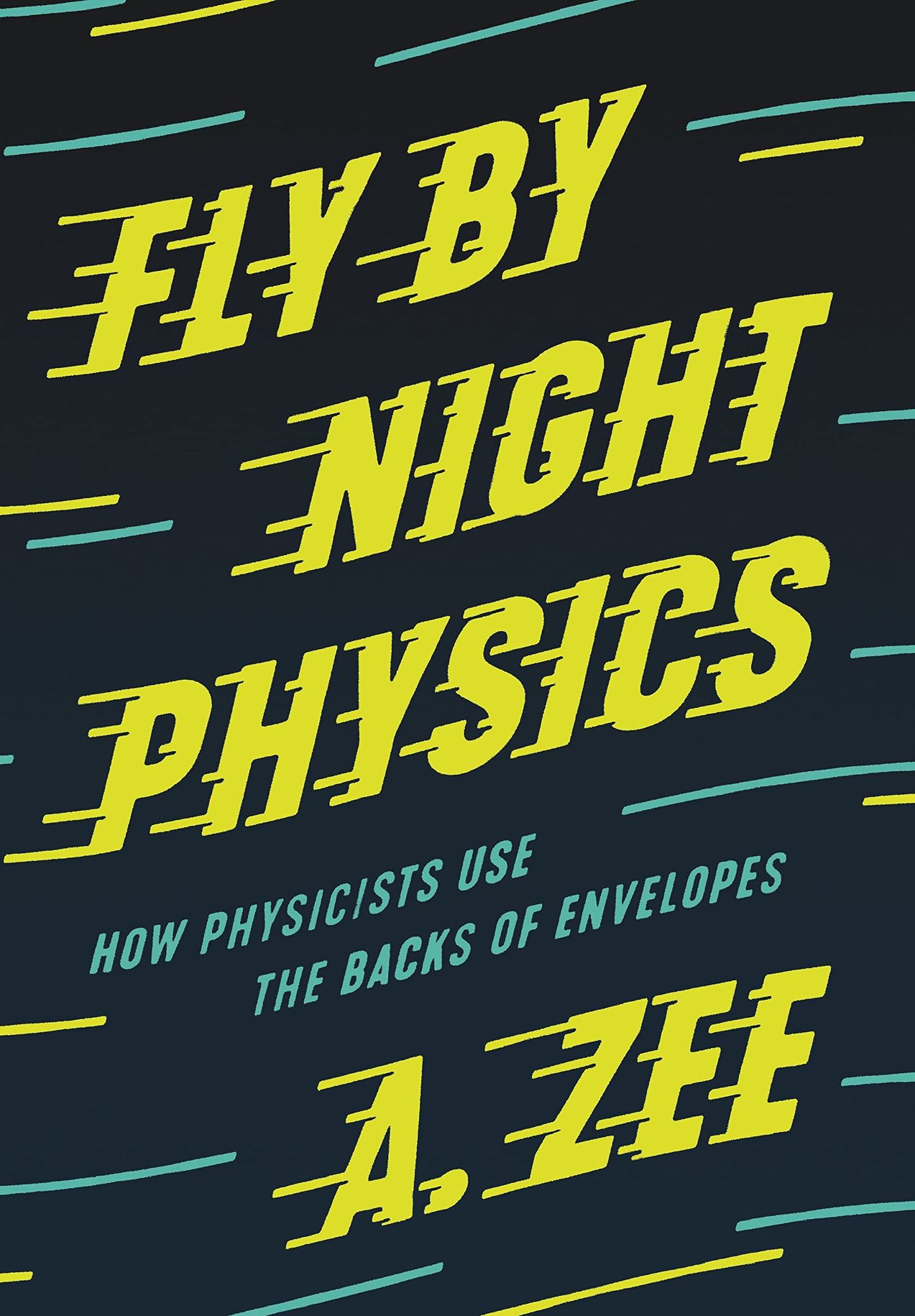
Jay Orear (Fermi’s collaborator and author of general physics textbooks) to the question “what is physics?” answered: “Physics is what physicists do late at night.” reminded us a few days ago Scientific Stories. Here “Fly by night physics” (more or less: physics in flying at night) is what physicists really do late at night, a good book about what is not taught in books: misuse of the back of envelopes, arm’s length estimates of orders of magnitude, dimensional analysis, conjecture about the variables involved, screwed and carped logical leaps, genius ideas that can only come to you at dawn after a sleepless night, so much so that the morning exists only to sleep late. In courses students are generally required to perform precise calculations, mastering a huge array of complicated mathematical methods. Idealized textbook exercises and problems in assigned assignments and exams reinforce the mistaken impression that science is the application of rigid recipes, and the effort to do more or less complex math. As a result, even the best students may find themselves completely unprepared for the challenges of work, in research or industry. Unless they meet an excellent lecturer on their way. In my case, I had Giorgio Salvini (the “father” of the Frascati INFN electrosyncrotron), who always insisted on correctly estimating orders of magnitude, and considering size, before throwing his head down and doing calculations. John Archibald Wheeler (the inventor of the term “black hole” and much more) used to tell his students (including Feynman): “Never calculate anything ever unless you already know the answer!” True science is made up of critical and creative thinking, deep insights, and calculators and computers are used for calculations. Exact counts, done in the head or on a piece of paper, do not always matter.
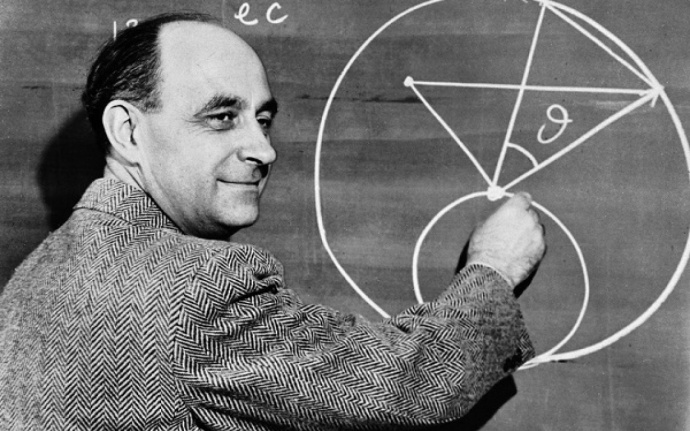
Whenever possible one should try to solve problems in the manner of Fermi, most famously his calculation of the power of the first atomic bomb in the Los Alamos experiment by throwing slips of paper in the air, and watching as they flew away in the wind of the explosion. Today, in applied mathematics, we commonly call “Fermi problems” those in which we find estimates and approximations very close to the true value, for quantities that seem impossible to calculate, given the limited information available. Showing the importance of making reasoned assumptions, clearly identifying the assumptions made, and not neglecting dimensional analysis. Stimulated as a freshman by these suggestions, I remember immediately going to MIR Italy-Russia, then in Piazza Esedra, not far from the university, to buy Leonid Sedov’s classic text, “Similarity and Dimensional Methods in Mechanics,” another great read on the subject, which I still keep in my bookshelf along with this and a book by Sanjoy Mahajan [see comments]. “Fly by Night Physics” is precisely a book about “Fermi-like” estimation, about how with very little and very simple math and a lot of physics intuition one can arrive at profound results.
Note how in the examples the author uses the simplest, eighth-grade math to solve complicated problems in more advanced fields of research. After an introduction on fundamental dimensions and constants we have 9 chapters, explanatorily titled:
- Dimensional analysis: from a not-so-secret fact to an allegedly secret weapon
- Telecommunication is possible
- Quantum physics: stars, tunnelling, scaling, atoms, and black holes
- Planck gave us the units: black hole radiation and Einstein’s gravity
- From ideal gas to Einstein’s condensation
- Symmetry and superb theorems
- Stars, black holes, the universe and gravitational waves
- From surfing to tsunamis, dripping faucets to mammalian lungs
- From private neutrinos to quark charm In the delightful appendix: Critical points; Delta function; Einstein gravity; From Euler to Navier and Stokes; Finite rectangular [potential] well; Galilean invariance and flow of a fluid; Green’s functions; Group velocity versus phase velocity; Radial part of the Laplacian; Maxwell’s equations; Newton’s two superb theorems and the square root alarm; (Flying by day) Derivation of van der Waals’ law from first principles; Chronology; Exercises; Suggested readings.
The price set by Princeton University is quite exorbitant for 430 pages (about 45€), one can resort to the library and used, unsold, and so on. There are free online resources to delve into this topic [especially the courses at MIT by Sanjoi Mahajan]
For other materials and online resources see:

Anthony Zee is a well-known scientist and lecturer, full professor of theoretical physics at UCSB (University of California at Santa Barbara), author of textbooks on quantum field theory and general relativity, and popular books for all, some of which have even been translated into Italian. Undergraduate textbooks include those in the “in a nutshell” series (in a nutshell for yankees)
- Quantum Field Theory in a Nutshell (2010)
- Einstein Gravity in a Nutshell (2013)
- Group Theory in a Nutshell for Physicists (2016) Among the “popular” books we also find a text on Chinese cuisine (but we know from reliable sources that he also appreciates Italian recipes):
- An Old Man’s Toy: Gravity at Work and Play in Einstein’s Universe (1989)
- Swallowing Clouds: A Playful Journey Through Chinese Culture, Language, and Cuisine (2002)
- Fearful Symmetry: The Search for Beauty in Modern Physics, (2007)
- On Gravity: A Brief Tour of a Weighty Subject (2018) trad.it. “Gravity: Light treatment of a heavy subject.”
- Quantum Field Theory As Simple As Possible (2023)