Physical World - Manton & Mee
N.Manton, N.Mee - The Physical World: An Inspirational Tour of Fundamental Physics (2017)
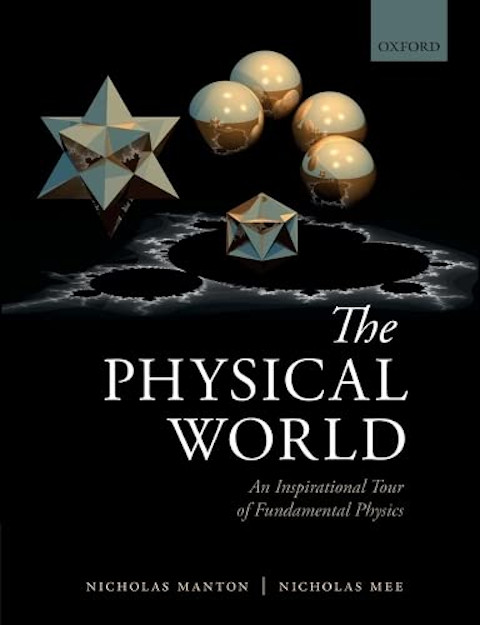
A beautiful volume that provides a comprehensive, unified, authoritative and up-to-date overview of Physics, which cannot be easily placed in a standard category. It is not and is not intended to be a textbook, a textbook for a university course, such as those by Feynman or Shankar, for example. It is not only intended for physics students, but also for those who are studying or have studied other scientific or technical subjects (mathematics, chemistry, science, computer science, engineering,…) and in general for curious people with at least a secondary education (diploma), who want to know something about contemporary physics. This is not an extension text for everyone; it requires some commitment on the part of the reader. A minimum knowledge of basic mathematics (algebra, geometry, vectors, derivatives and integrals) is very useful,however sufficient as a basic preparation is that of high schools and technical colleges, many formulas can be skipped without problems for understanding the subject. Since the publication of Feynman’s Lectures in Physics has now been nearly sixty years, a new account was needed authoritative of general physics for non-specialists. The book meets this demand because it starts from the mechanics of Galilei and Newton to Aspect’s experiments on Bell’s inequality (Nobel 2022), the Atlas and CMS experiments at CERN with the discovery of the Higgs boson (Nobel 2013), the LIGO experiment with the detection of gravitational waves (Nobel 2017). In the ’last chapter, the limits of the standard model of elementary particles, solitons and skyrmions, supersymmetry and string theory are mentioned.
the topics covered are:
- Fundamental ideas.Motion of bodies, Newton’s laws.Fields, Maxwell’s equations.
- Special relativity.Curved spaces.General relativity.
- Quantum mechanics.Quantum mechanics in 3-D.Atoms, molecules and solids.
- Thermodynamics.Nuclear physics.Particle physics.
- Stars.Cosmology.Frontiers of Physics. The presentation is clear and concise, totaling just over 500 pages, and follows the dictum (attributed to Einstein) that “explanations should be made as simple as possible, but not simpler,” expounding only conceptual principles without unnecessary calculations and details to non-specialists.At the end of each chapter a brief bibliography advises where to go further on the subject.The authors are theoreticians but the treatment is well balanced between theory and the physical meaning of the concepts, predictions and experimental confirmations, avoiding too much insistence on mathematical formalism.Many color illustrations complete the exposition and facilitate reading and understanding. The central idea for giving a unified and coherent view of the subject is the use of variational, minimum-action principles, an approach that lies at the heart of modern theoretical physics, but has been neglected in most introductory accounts of the subject, with the commendable exception of Jennifer Coopersmith’s “The Lazy Universe.” At the cost of overshadowing a bit, if I have to make a criticism, the principles of symmetry and invariance. A bit too narrow is also the space devoted to the theory of condensed states of matter. The interdisciplinary physics of complex systems, dynamical systems, and chaos are completely absent. To supplement it on these points, one can consult an overview of modern physics with an entirely different approach, e.g., “Invitation To Contemporary Physics,” 2nd ed. 2012, by Ho-Kim Quam, Kumar, Lam [will be reviewed later].
Nicholas Manton is a full professor of theoretical physics at the DAMTP (Department of Applied Mathematics and Theoretical Physics) at the University of Cambridge (UK), practically sitting on the Newton Chair, and researching solitons and quantum field theories. Nicholas Mee is a physicist, a computer scientist, and the author of many successful popular texts (much less challenging readings), for example:
- Gravity: From Falling Apples to Supermassive Black Holes
- Celestial Tapestry: The Warp and Weft of Art and Mathematics
- The Cosmic Mystery Tour: A High-Speed Journey Through Space & Time
- Higgs Force: Cosmic Symmetry Shattered
- Gravity: Cracking the Cosmic Code The book is published by Oxford University at a reasonable price for the value of the work of over 500 pages, about €25 for the ebook; the print edition can also be found online at around €30.