The QED Revolution and the Nobel Prize to Feynman
The importance of the revolution brought about in Quantum Electrodynamics (QED) and the motivations that led to Richard Feynman’s Nobel Prize.
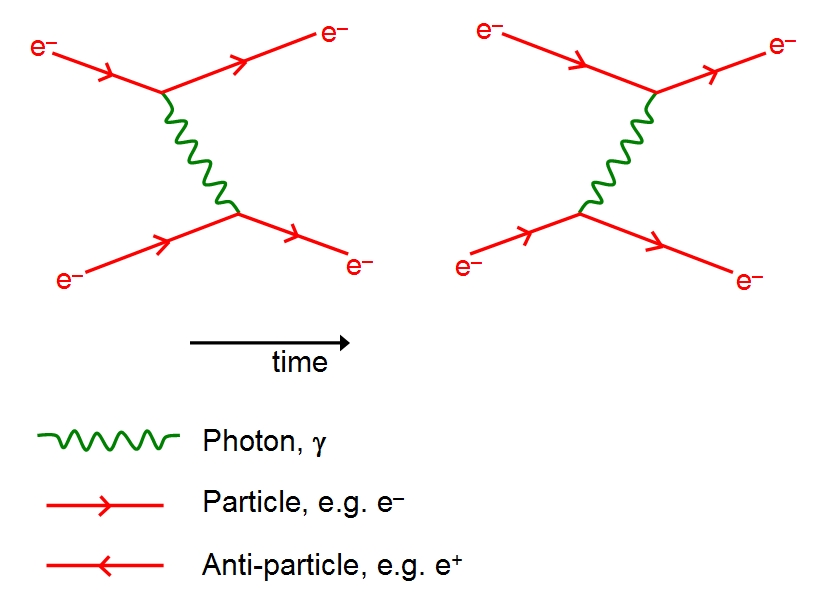
QED is first quantum field theory. Maxwell and Einstein had developed classical (non-quantum) field theories for electromagnetism and gravitation. Dirac a quantum mechanics for relativistic charged particles. But a true quantized field theory was needed, QED
QED as a coherent, covariant and renormalized theory, i.e., with elimination of infinities in calculations, of developments in perturbative series. interaction with the electromagnetic field can be treated as a perturbation to the case of the free charged particle, but infinite terms appeared in the calculations, and in initial attempts to develop a quantum and relativistic theory of the electromagnetic field the serial development diverged (works of Dirac, Pauli, Wigner, Heisenberg, Fermi, Oppenheimer, Weisskopf, Bloch,…). dirac had introduced the second quantization and particle creation and destruction operators, but it worked only at the first order of approximation, the later terms diverging, as shown e.g., by Weisskopf.
Independently of Feynman and with different methods, Julian Schwinger and Sin-Itiro Tomonaga also succeeded in eliminating the divergences, after an early insight by Hans Bethe, in which infinities were reabsorbed into the charge and mass of “dressed” particles, i.e., interacting with the field (renormalization) . freeman Dyson showed the equivalence of their approaches. The development terms all become proportional to the powers of the fine structure constant divided by pi, about 1/430, and converge rapidly, e.g., (1/430)^2 = 0.000005 as a factor for the second-order correction term.
The end result is that QED in the formulation of Feynman, Schwinger, Tomonaga and Dyson, who were awarded the Nobel Prize in 1965, is the “Jewel of Science.” the only theory ever developed by man that succeeds in calculating and predicting the true value of certain measurable quantities, such as the anomalous magnetic moment of the muon and the lamb shift of hydrogen energy levels, with an accuracy equivalent to shooting a gun from the earth and hitting a fly in the butt on the moon with the bullet.
Feynman devised a visualization of the interactions in the terms of perturbative series developments, with his famous diagrams, which greatly facilitates the understanding of the calculations and their physical interpretation.
Finally Feynman developed a revolutionary new formulation of quantum mechanics with the idea of integrals over paths, the calculation of the probability amplitude over all possible paths joining two quantum states of the system. the contribution of a single path is proportional to the imaginary exponential of S, the classical action as the integral in time of the Lagrangian (and divided by the reduced Planck constant). An alternative to the first and second quantizations that has proved very useful in understanding modern field theories.
The method of sums of probabilities on the paths shows an interesting analogy between Schrodinger’s equation and a classical diffusion equation such as that of Brownian motion. With a Wick rotation, a quantum field theory is a statistical mechanics with imaginary time. This leads to an understanding of how fruitful the “cross-fertilization” between the two fields of theoretical physics is. in fact, the renormalization procedure, and the mechanism of spontaneous symmetry breaking, can be fully understood only in statistical mechanics and physics of condensed states of matter, with Wilson’s renormalization group, Landau’s phenomological theory of phase transitions, Anderson’s superconductivity theory.
i cammini sono tutte le “storie” possibili, tutti i percorsi immaginabili tra i due punti, anche se violano le leggi della fisica, ad es. i principi di conservazione. Se l’elettrone è nel punto A e voglio calcolare la probabilità di trovarlo tra x secondi nel punto B, sommo le ampiezze di probabilità su tutti i cammini possibili tra i due punti, con un’opportuno peso, o meglio fase, dipendente dall’azione. In QM si sommano le ampiezze che sono numeri complessi, non direttamente le probabilità come nel caso classico. Questa ampiezza così calcolata soddisfa anche l’equazione di Schrodinger, che quindi è una formulazione equivalente all’integrazione sui cammini. Si derivano l’una dall’altra, nel senso che partendo dall’integrale sui cammini di feynman su un intervallo di tempo infinitesimale si ricava l’equazione differenziale di Schrodinger. the contribution of the paths away from the classical trajectory is weakened by interference between the contributions to the wave function. In the classical limit it is suppressed altogether and only one path remains, the one with the minimum action.
The idea of a possible path for a particle in spacetime seems to me even more intuitive than diagrams (which are not descriptions of events in spacetime, as is sometimes confused). in classical mechanics, in the simplest case of a point particle, the Lagrangian function is the difference between kinetic energy and potential energy, and drawing the graph of its evolution in time, the area underneath is the action of the path taken by the particle. In classical, deterministic mechanics, there is only one possible path, the one for which the action is minimal, because of the principle of “the laziness of the universe” (Jennifer Coopersmith, The Lazy Universe). in Feynman’s quantum mechanics, all paths are possible, and the magnitude of the probability of a particle “propagating” from one point to another in spacetime can be calculated by summing all the possible paths of the particle between the two points, with an appropriate weight for each path, dependent on the action. so many possible paths between two points are also studied in statistical physics, in the case of stochastic, random processes, such as random walk and Brownian motion, thermal diffusion phenomena. So something popular about statistical physics should also be read before tackling quantum mechanics and quantum electrodynamics.
Online resources
There are interesting posts in “Asymmetries,” INFN’s popular magazine, e.g., “Asymmetries.
- https://www.asimmetrie.it/l-infinito-sotto-il-tappeto
- https://www.asimmetrie.it/index.php/un-mare-di-antimateria
- https://www.asimmetrie.it/precisamente-anomalo
- https://www.asimmetrie.it/in-primo-piano/1383-la-luce-interagisce-con-se-stessa-alle-alte-energie
To delve deeper into the subject but “in a nutshell” , there are the Treccani entries , edited by Emilio Picasso (Enciclopedia del Novecento) and Francesco Calogero (Enciclopedia Italiana):
- https://www.treccani.it/enciclopedia/elettrodinamica-quantistica_%28Enciclopedia-del-Novecento%29/
- https://www.treccani.it/enciclopedia/elettrodinamica-quantistica_%28Enciclopedia-Italiana%29/
Don’t forget that lectures from Feynman’s legendary Physics course are always online:
Books
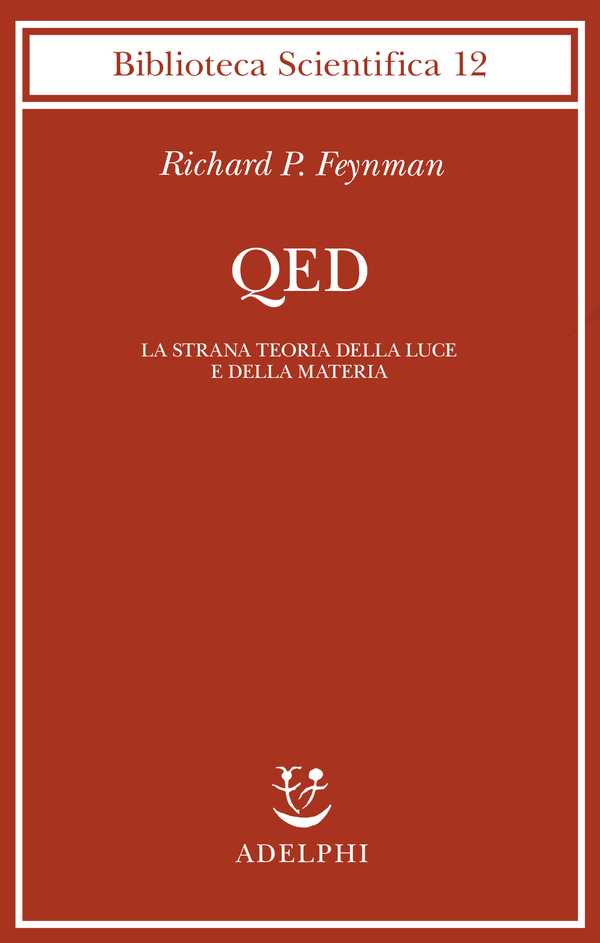
It is obvious that no one can ever give a better popularized explanation than Feynman himself in: “QED The Strange Theory of Light and Matter.”
There are no equations in Feynman’s book, just some drawings. It is a transcript of a series of popular lectures for the general public held at UCLA (University of California Los Angeles) in 1983. Of course, even dispensing with mathematical formalism, the concepts he expounds are far from simple, but no prior knowledge of the subject is required. Perhaps read together with “Six Less Easy Pieces,” where Feynman collects some of his introductory lectures on the fundamental concepts of physics: spacetime, symmetry, relativity.
Recent excellent popular books are:
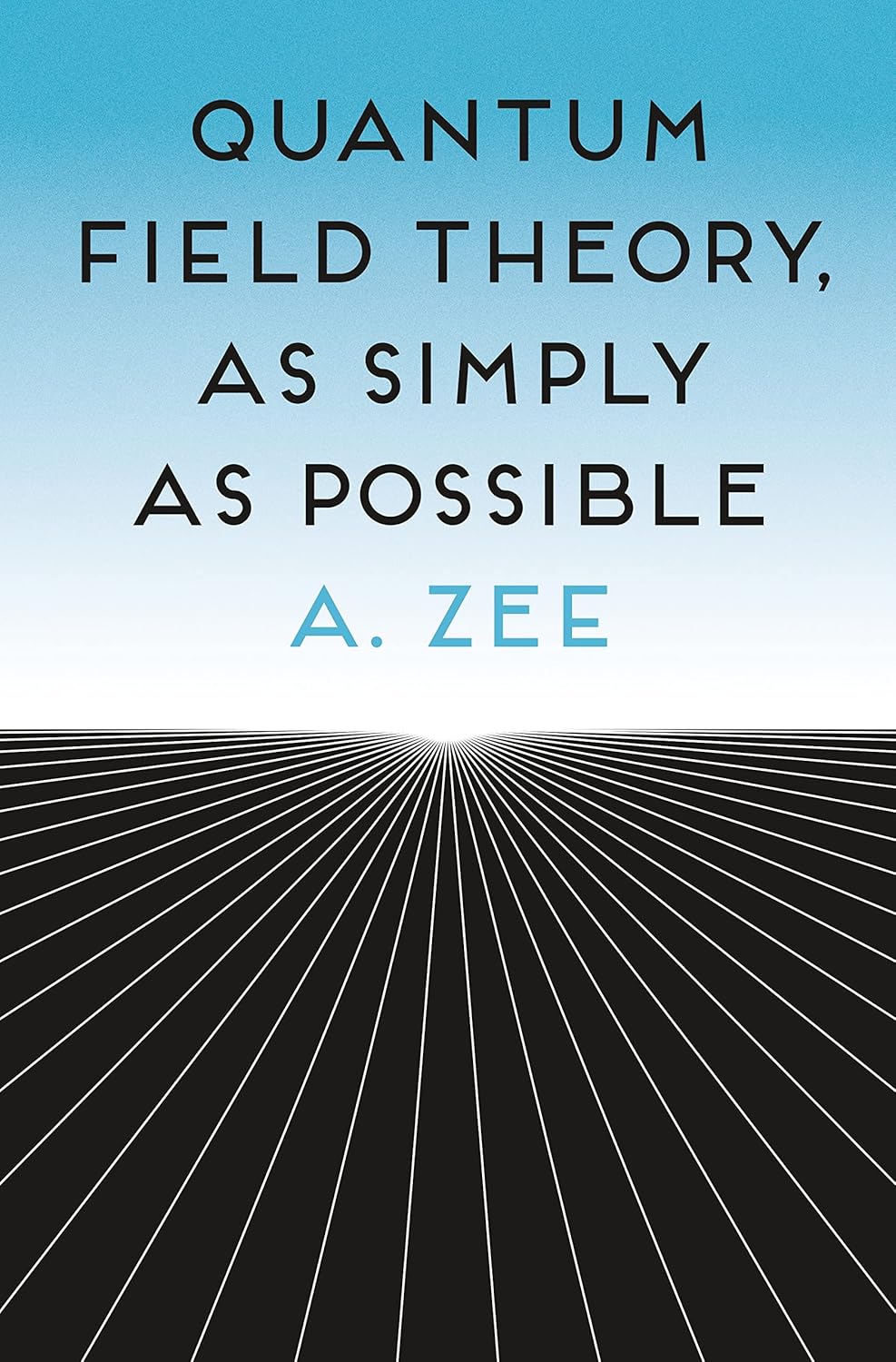
- Anthony Zee - “Quantum Field Theory,” As Simply As Possible, 2023
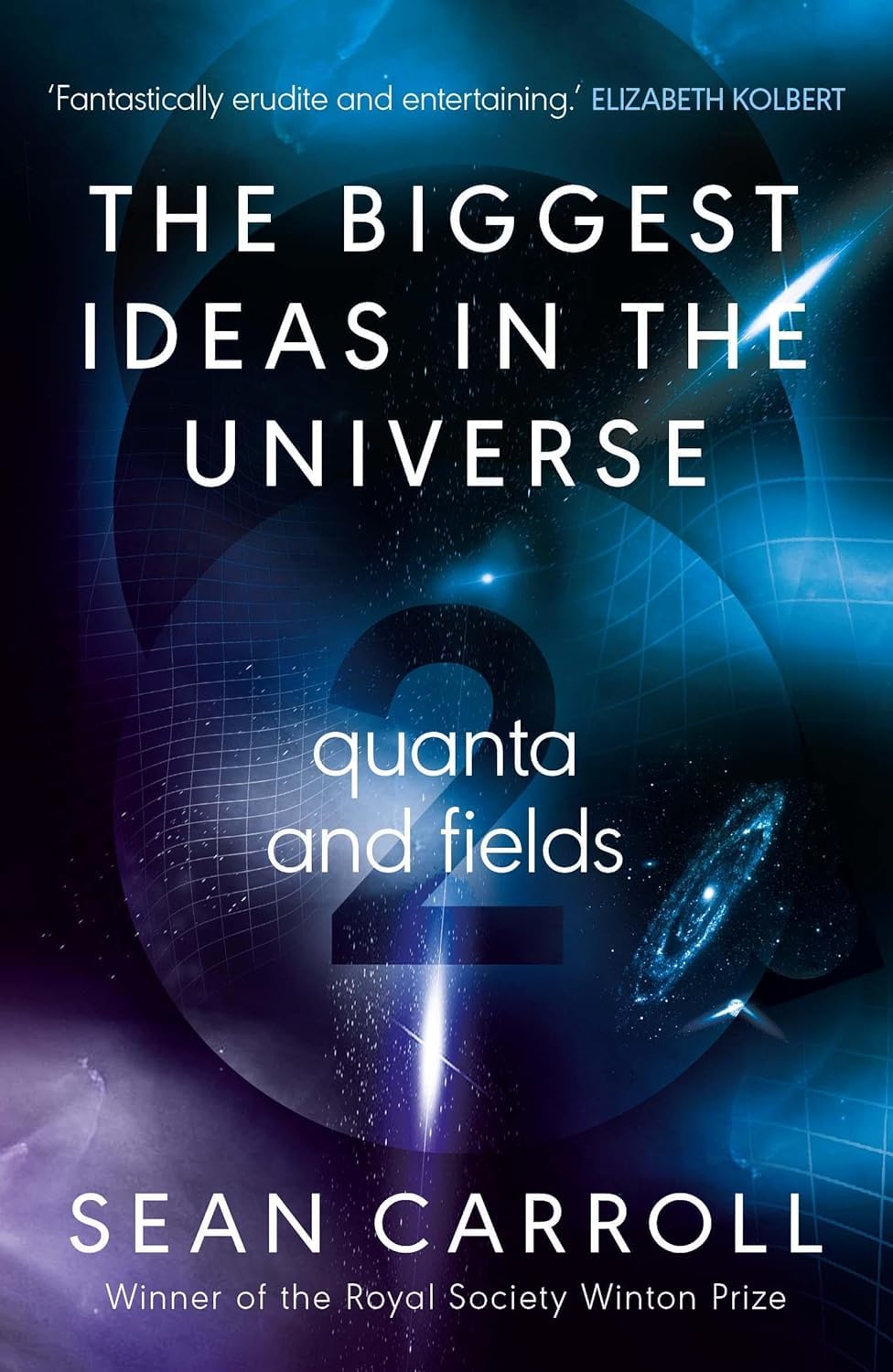
- Sean Carroll - “Quanta and Fields,” The Biggest Ideas in the Universe Vol. 2, 2024
They are in English, but Sean Carroll’s Italian translation should be published soon.
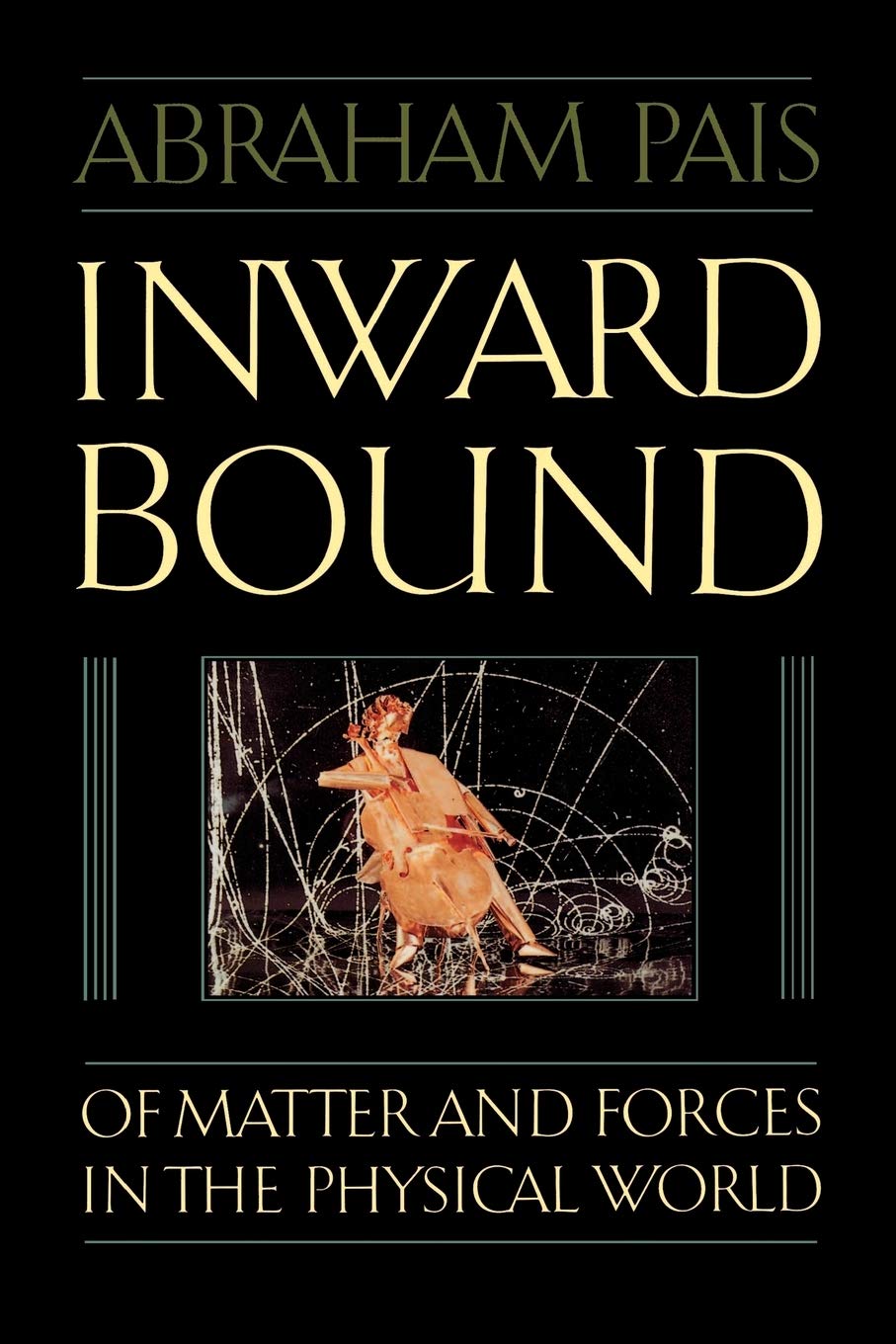
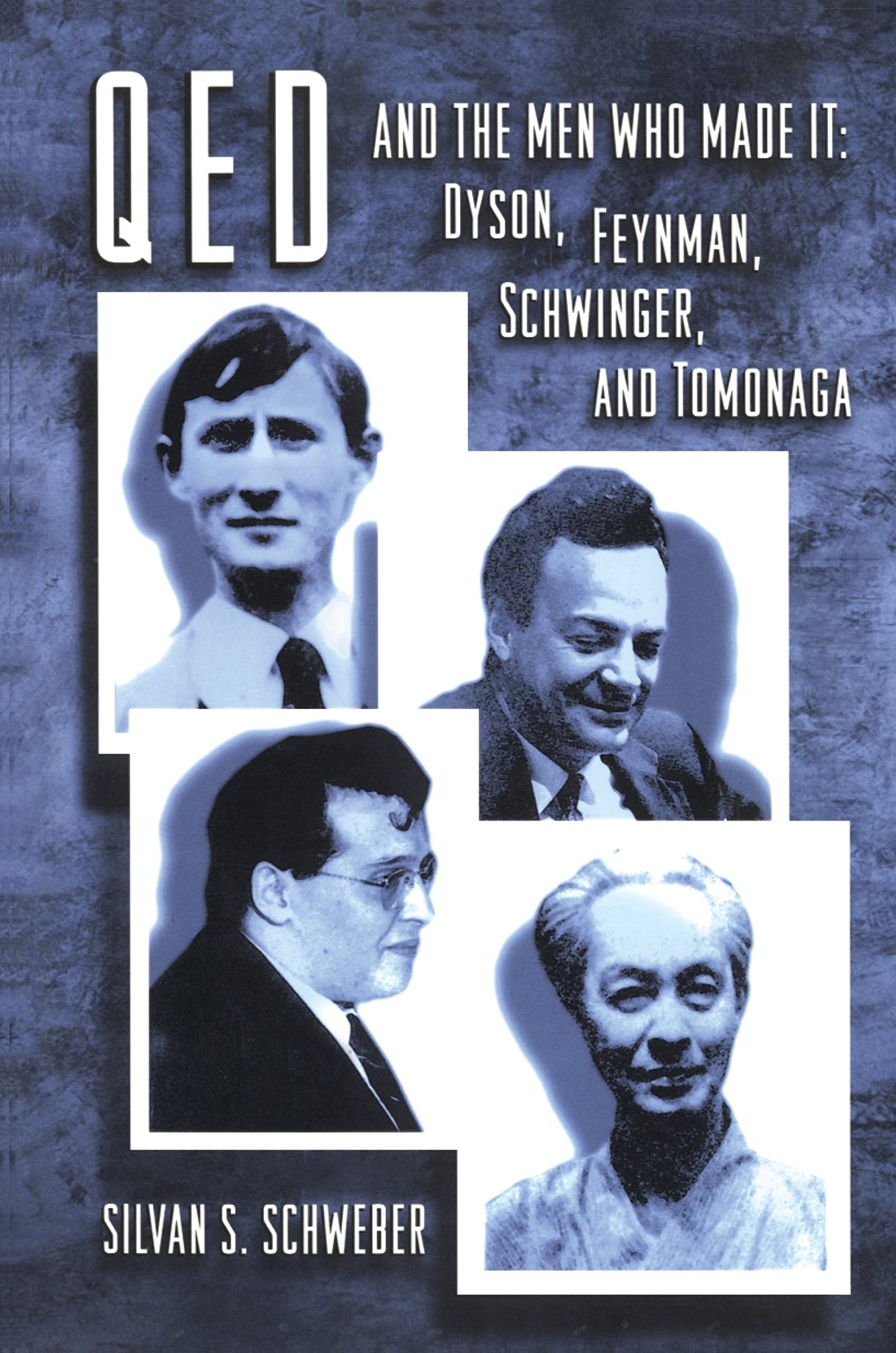
For the history of the development of quantum electrodynamics there are two very useful texts, by Scwheber and Pais, but in English and at a fairly advanced level.
- Silvan S. Schweber “QED and the Men Who Made It: Dyson, Feynman, Schwinger, and Tomonaga” (1994). The most detailed account of a scientific revolution.
For a more concise exposition see chapters 15,16 and 18 devoted to QED by:
- Abrahm Pais in “Inward Bound: Of Matter and Forces in Physical World,” a history of particle physics from 1897 (Thomson) to 1983 (Rubbia). A straightforward account by one of the leading lights of QED, a theoretical physicist and professor at Princeton. Even this cannot be called exactly popularized, but the layman can follow the reasoning by skipping over the formulas and details.
Last but not least, if one really wants to become a super expert in QED, at the level of a master’s degree in physics, i cite manuals that are also excellent for self-taught people:
- Robert D. Klauber - Student friendly Quantum Field Theory, vol.1 Basic Principles and QED
- Stephen Blundell, Tom Lancaster - Quantum Field Theory for the gifted amateur
- Richard D. Mattuck - A Guide to Feynman Diagrams in the Many-Body Problems
Feynman and Hibbs’ classic volume on the reformulation of Quantum Mechanics was re-edited and corrected by Daniel Styeri a few years ago:
- Richard P. Feynman, Albert R. Hibbs, Daniel F. Styer - Quantum Mechanics and Path Integrals - (emended edition 2010).
Curiosities
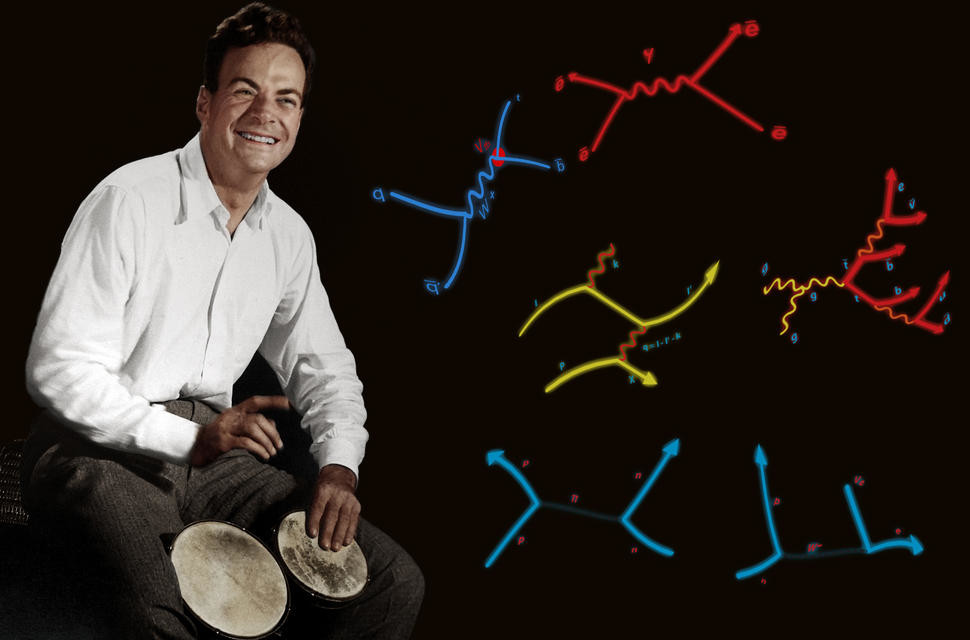
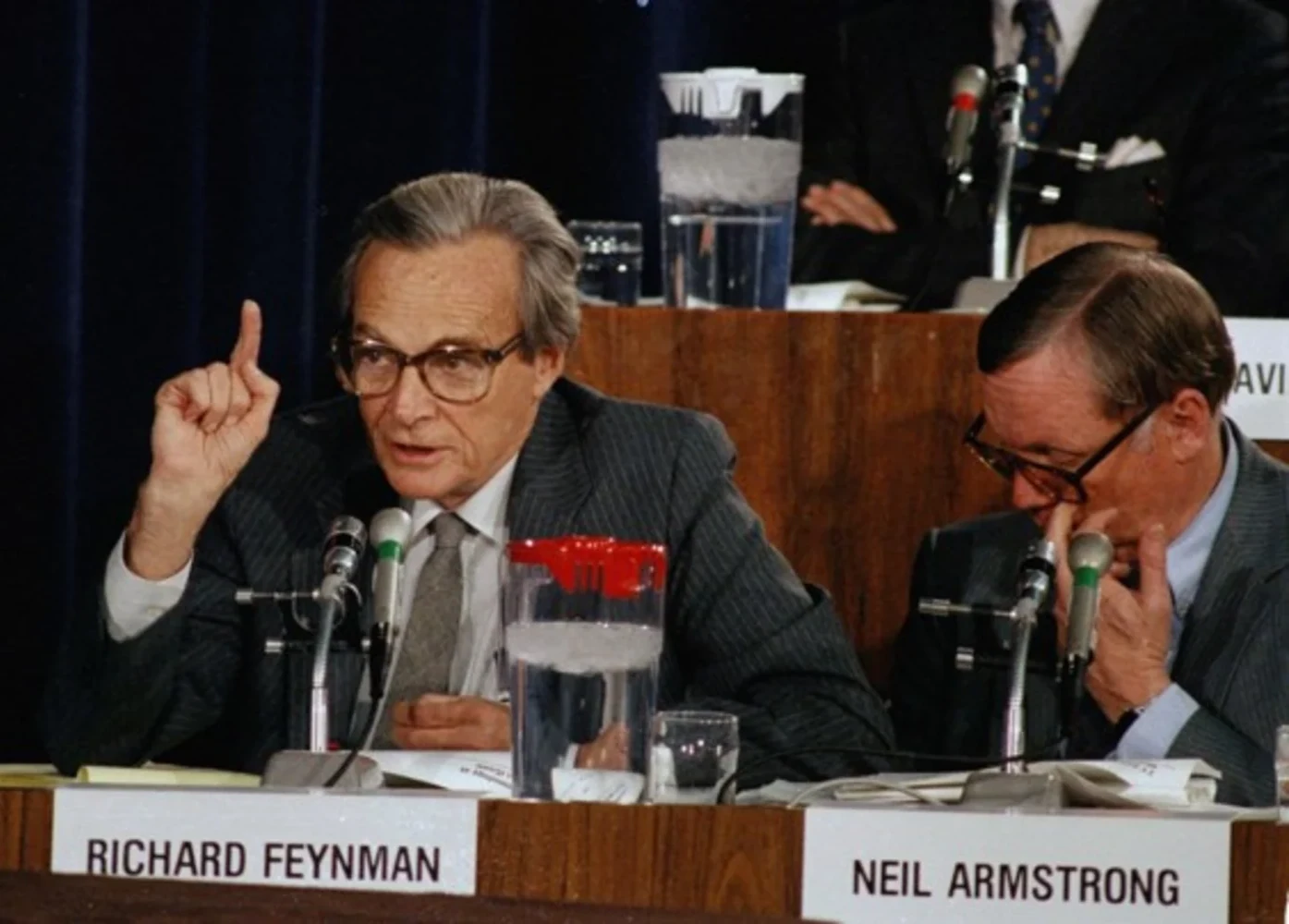
When he was not engaged in calculus Richard Feynman liked to play bongos in jazz clubs and nightclubs. Often after the Nobel he used an infamous topless bar and strip club as his private office of Pasadena (Gianone’s or Giannoni’s depending on sources), less than a kilometer from his residence and not too far away from CalTech (California Polytechnic Institute). Here he concentrated in his studies and complicated calculations and received colleagues, students and politicians, usually pleased to be served by very attractive and scantily clad maids, or drew portraits of the girls. When the club’s owner and employees were arrested for obscenity he showed up at the trial to testify in favor, and used all his influence as a Nobel laureate and professor at Caltech to gain acquittal. He sometimes drew portraits of the girls, and original drawings of the club’s dancers were auctioned at Sotheby’s for high figures. Between a lapdance show and a strip-tease he invented the theory of superfluidity of liquid helium, the parton/quark model of elementary particles and especially nanotechnology and quantum conputing, exerting a great influence on the future progress of science and technology. As a young man, he had participated during the war in the Manhattan Project of the atomic bomb, and amused himself by ridiculing all the security measures at Los Alamos labs. But alas at that time his first and beloved wife was dying, at only 20 years old from leukemia. Member of the Presidential Commission of Inquiry into the Space Shuttle Challenger explosion, became famous among the general American and international television audience in 1986 when he explained the cause of the disaster live with a spectacular experiment, immersing a sample of the o-rings (tank gasket) in a glass of ice water showed that it had become less resistant and sealant due to the great cold weather of the night before the launch at Cape Canaveral. His entertaining autobiographical books are also very famous, You’re kidding, Mr. Feynman! and _What do you care what people say? the collections of popular lectures, aphorisms and letters (The Physical Law, The Sense of Things, Six Easy Pieces, …), and the numerous biographies including Tuva or Bust! by Ralph Leighton, Genius by James Gleick, Quantum Man by Lawrence Krauss, ottaviani & Myrick’s comic strip story Feynman.