Mathematics Form and Function - Mac Lane
Saunders Mac Lane - MATHEMATICS FORM AND FUNCTION
1st ed. 1986, reprinted 2012 " Incredibly beautiful. … If you know the maths read it for the simple joy and new perspective. If you don’t know the maths read it to get a sense of what beautiful things exist and what’s out there to learn."
[Incredibly beautiful. … If you know math read it for pure pleasure and new perspectives. If you don’t know math read it to get an idea of how many beautiful things exist out there to learn.] (Anomymous Online Reviewer)
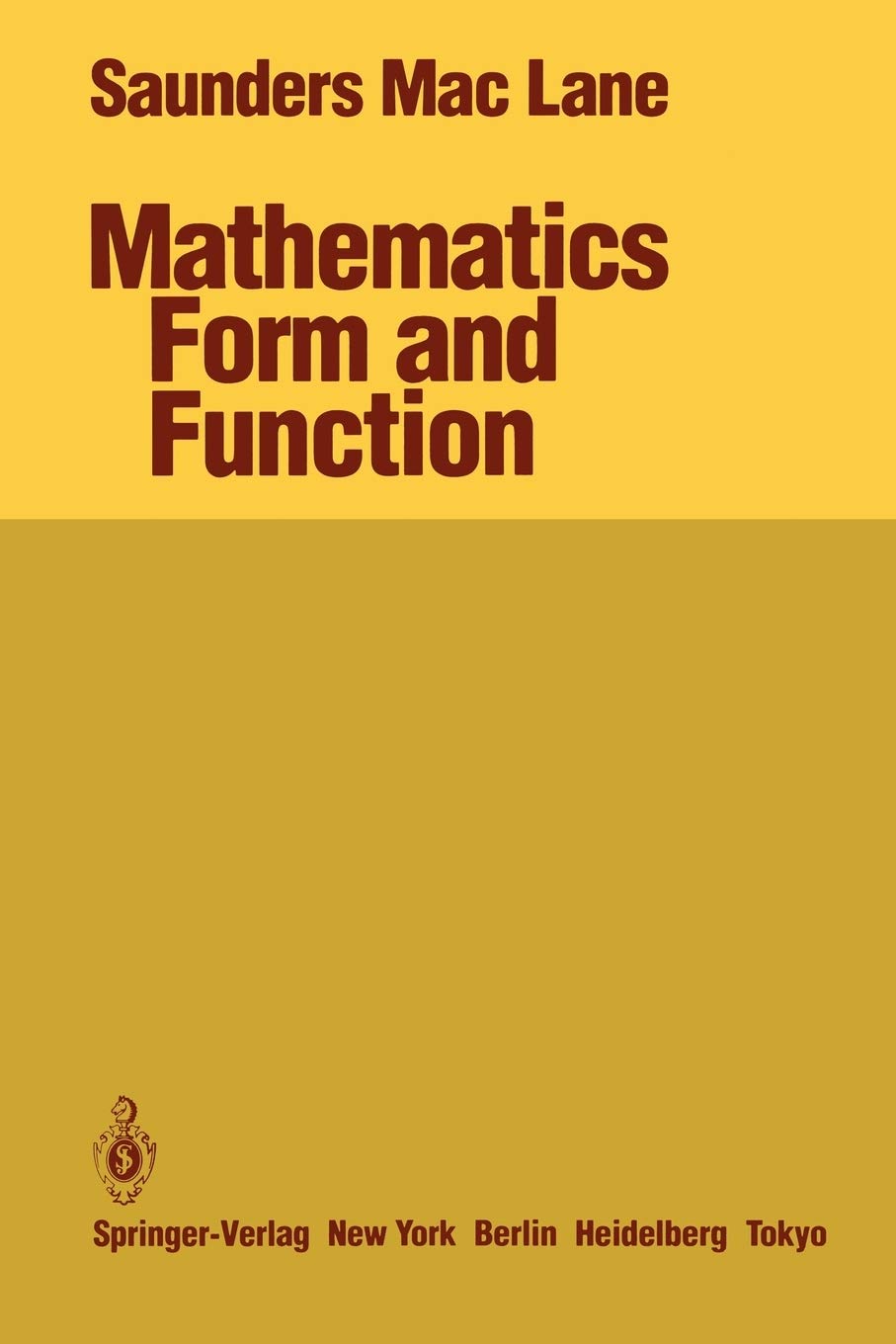
In modern mathematics, increasingly general and abstract languages and concepts, abstruse to some, have been developed. The revolution began 150 years ago with Georg Cantor’s Set Theory (“no one can kick us out of the paradise Cantor created for us,” said David Hilbert), and continued in the first half of the 20th century with the study of “structures” defined on sets. Structures that may be algebraic, topological, discrete or other. Finally after World War II came Category Theory, which studies the relationships between mathematical structures with notions of class, objects, morphisms and functors. It is a basic unifying concept for pure and applied mathematics, theoretical computer science, and mathematical physics.
The creators of the new general language for these disciplines are Samuel Eilenberg and Saunders Mac Lane, the author of this beautiful volume. The work passes
in review of the whole of mathematics, including the origin of its concepts and the deeper relationships between them, and with human activities, both abstract and
concrete.But it is not a text on the history of the subject and does not follow chronological order.The result is a book that is read with great pleasure even by those who
is not a professional mathematician (e.g., the writer, physicist and computer scientist), to reflect on the basics of mathematics, and look with a new point
of view of the most important concepts.
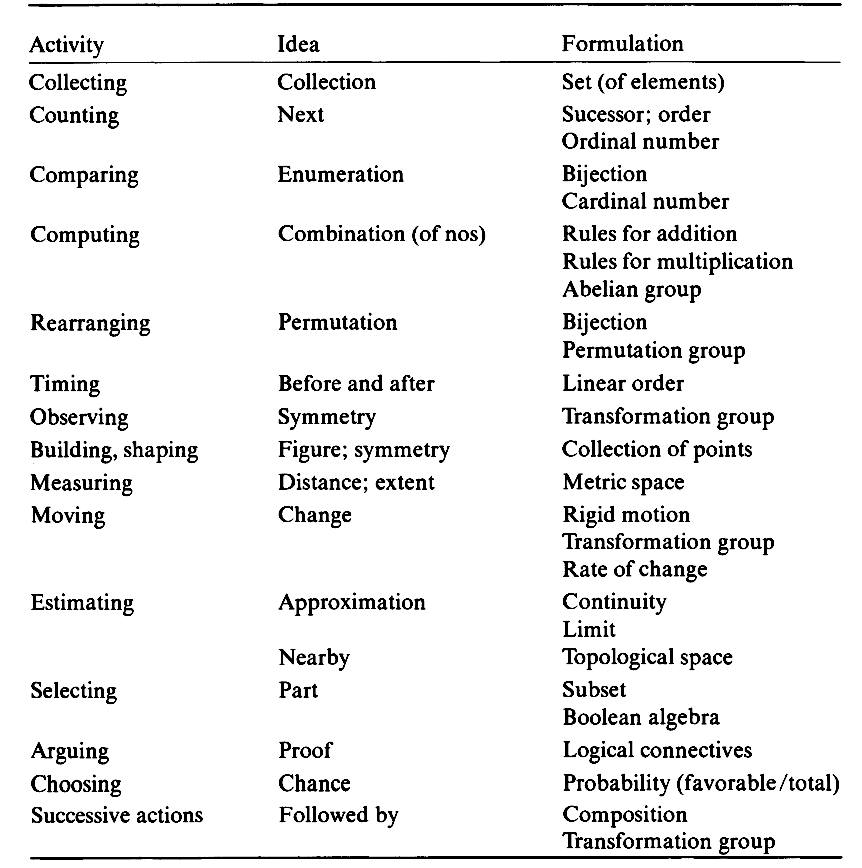
The text is divided into 12 chapters:
- Origin of formal structure
- From integers to rationals
- Geometry
- Real Numbers
- Functions, Transformations and Groups
- Concept of Calculation
- Linear Algebra
- Shapes of Space
- Mechanics
- Complex Analysis and Topology
- Sets, Logic and Categories
- The Math Network
totaling about 480 pages.
As the author himself explains in the introduction:
This book aims to describe the practical and conceptual origins of mathematics and the character of its development, not in historical terms, but in terms of intrinsic.We therefore ask: what is the Function of Mathematics and what is its Form? In order to effectively address this question, we must first observe what Mathematics is. Therefore, the book begins with a review of the fundamental parts of Mathematics, so as to answer the questions general on the basis formed by a careful amalgamation of the most relevant facts.
In short, a philosophy of mathematics is not convincing unless it is grounded in an examination of mathematics itself. From this point of view, Wittgenstein and the other philosophers have failed."
The volume is rather expensive and hard to find, to consult at the library, or buy used second-hand.
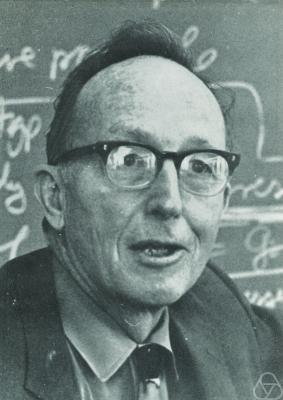
Saunders Mac Lane (1909 - 2005) is considered one of the most influential mathematicians of the 20th century. With Eilenberg, he founded Category Theory, a new language for Mathematics, in 1945. He worked on mathematical logic, algebraic topology, homological algebraics, and philosophy of mathematics. He revamped the teaching of the subject, publishing such celebrated textbooks as “A Survey of Modern Algebra” (with G. Birkhoff) and “Categories for the Working Mathematician.”