Concise History of Mathematics - D.J.Struik
- 1st ed. 1948, 4th revised and updated 1987, 6th reprint New York 2020


“Mathematicians grow very old; it is a healthy profession. The reason you live long is that you have pleasant thoughts. Math and physics are very pleasant things to do.” [“Mathematicians age a lot; it’s a very healthy profession. The reason you live long is that you have pleasant thoughts. Mathematics and physics are very pleasant things to do.”] Dirk Jan Struik (1894-2000)
Few men can boast of having spanned three centuries like Dirk Struik. He was born in the Netherlands in September 1894 and passed away in the United States in October 2000, at the ripe old age of 106, after celebrating: the dawn of the new millennium, eighty years of teaching and research on two continents as a mathematician and historian of science, and a lifetime of political and social engagement as an ideologue of the Dutch Communist Party and co-founder of the U.S.-based neo-Marxist journal “Science & Society.” After finishing his PhD, he went to Prague and married Czech mathematician Saly Ruth Ramler (first woman to obtain a doctorate from Univ. Carolina, in 1922!) The couple worked and taught in Holland(Leiden), Italy(Rome), Germany(Göttingen), the U.S. (Boston), collaborating with Jan Schouten, Tullio Levi Civita, Richard Courant and Norbert Wiener, and turned down generous offers to transfer to the Univ. of Moscow.
Persecuted by the U.S. government in the 1950s for his political views, he was banned from teaching for five years. But with the dark age of McCarthyism over, MIT had to give him back his professorship and full professorial salaries. He retired as professor emeritus after 34 years at MIT Boston, continuing to give lectures and lectures until he was 101, and finally published his last paper at the tender age of 102.
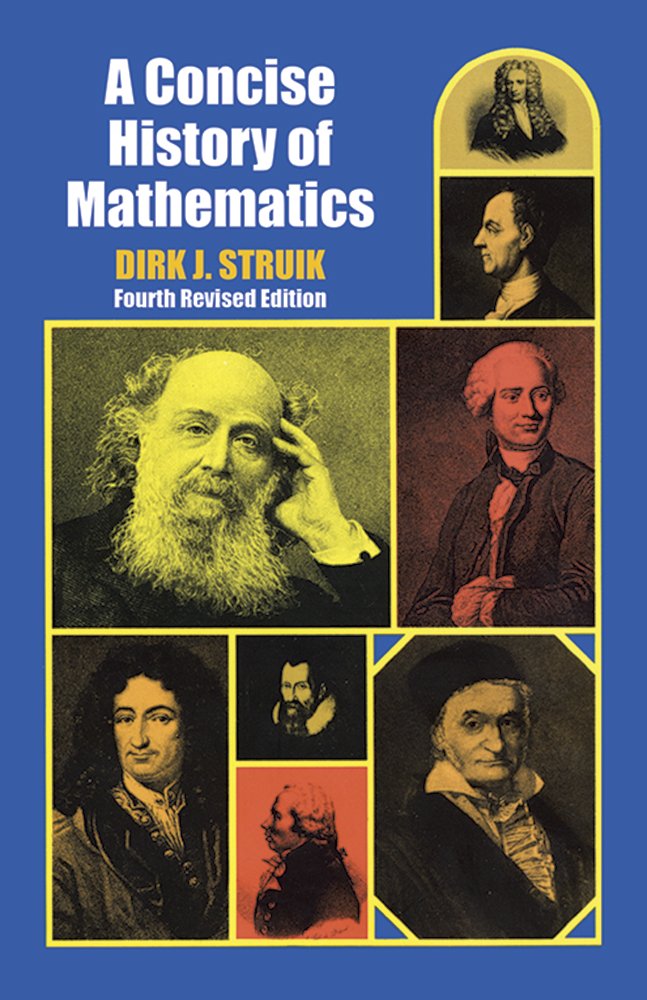
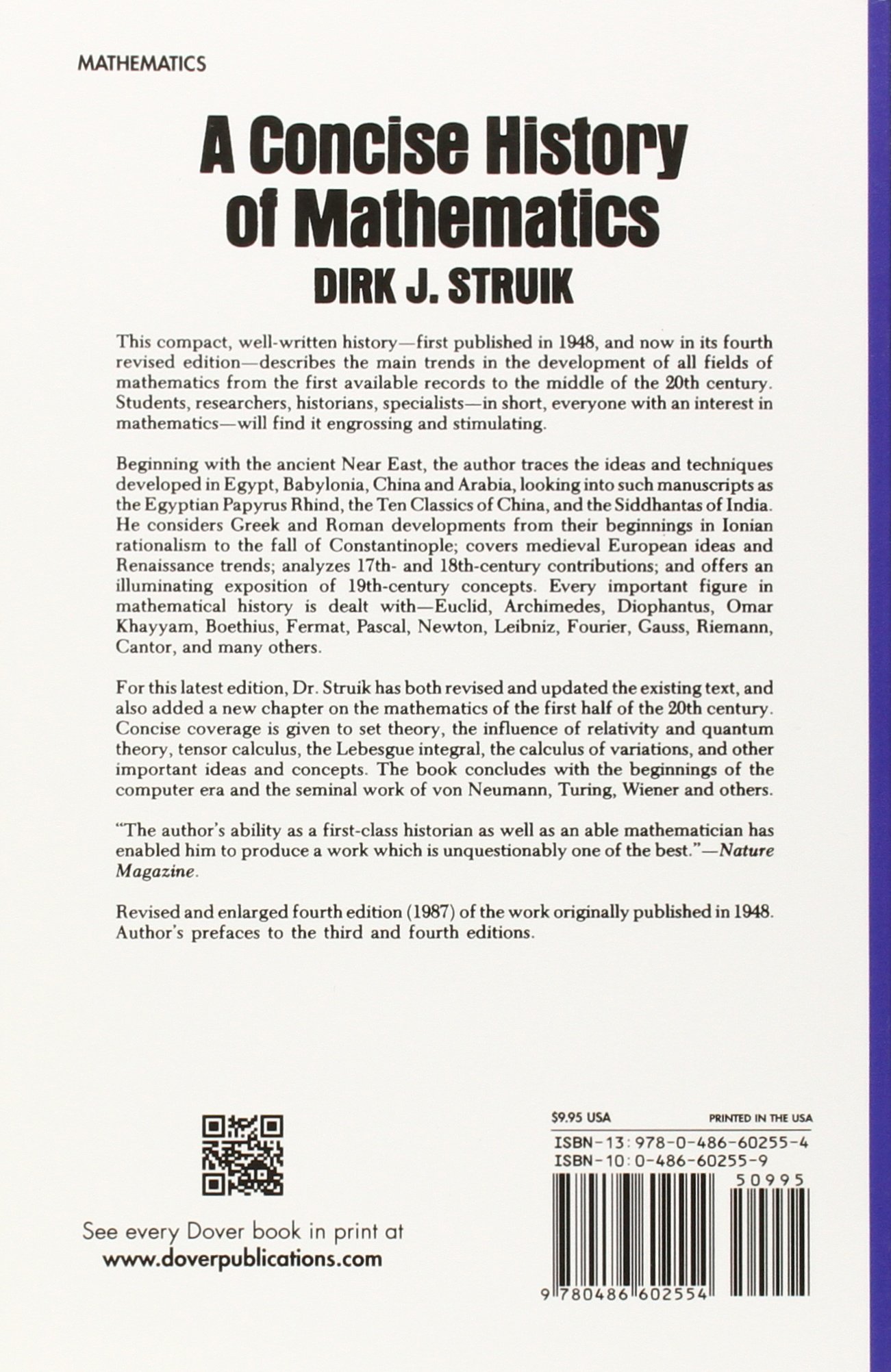
After the due introduction on the author’s fascinating history, let us return to the piece. The volume first appeared in 1948 and continually reprinted, it is now a best seller and a timeless classic in the history of thought. The latest edition revised and updated by the author is the fourth from 1987; the one I have in my hand is from 2020. One virtue of the volume is clear in its title (“Concise History”), the treatment is clear, concise and well written, and in about 200 pages it tells everything essential to know about the subject. Certainly the specialist with a professional interest in the history of the discipline must also consult other sources, such as the nearly 1,000 pages of Victor Katz’s “History of Mathematics,” the more than 1,500 pages of Morris Kline’s ponderous volumes of “History of Mathematical Thought,” the 650 in the 3rd ed. of Boyer and Merzbach’s History. But this historical summary describes the major trends in the development of all fields of mathematics from the earliest available records in prehistory to the mid-20th century, and is therefore most useful to anyone with an interest in the subject. The author traces the ideas and techniques developed in Egypt, Babylon, China, and Arabia, examining manuscripts such as the Egyptian Rhind papyrus, the Ten Classics of China, and the Siddhanta of India. He considers Greek and Roman developments from their beginnings in Ionian rationalism to the fall of Constantinople; covers medieval European ideas and Renaissance trends; analyzes seventeenth- and eighteenth-century contributions; and offers an illuminating exposition of nineteenth-century concepts. Every major figure in the history of mathematics is covered: Euclid, Archimedes, Diophantine, Omar Khayyam, Boethius, Fermat, Pascal, Newton, Leibniz, Fourier, Gauss, Riemann, Cantor, and many others. A concise discussion of set theory, the influence of relativity and quantum theory, tensor calculus, Lebesgue integral, calculus of variations, and other important ideas and concepts is provided. The book concludes with the beginning of the computer age and the seminal work of von Neumann, Turing, Wiener, and others. Another merit of the volume is its very honest price, in bookstores at €8-9, ebook online at about €6, within reach of the most modest budget, thanks to the ever-well-deserving Dover Publications of New York.