Elements of Mathematics - Stillwell
- John Stillwell - “Elements of Mathematics: From Euclid to Godel,” Princeton University Press, 1st ed., 2016
- John Stillwell - “From Pythagoras to Turing. elements of philosophy in mathematics,” ETS Pisa, 2018
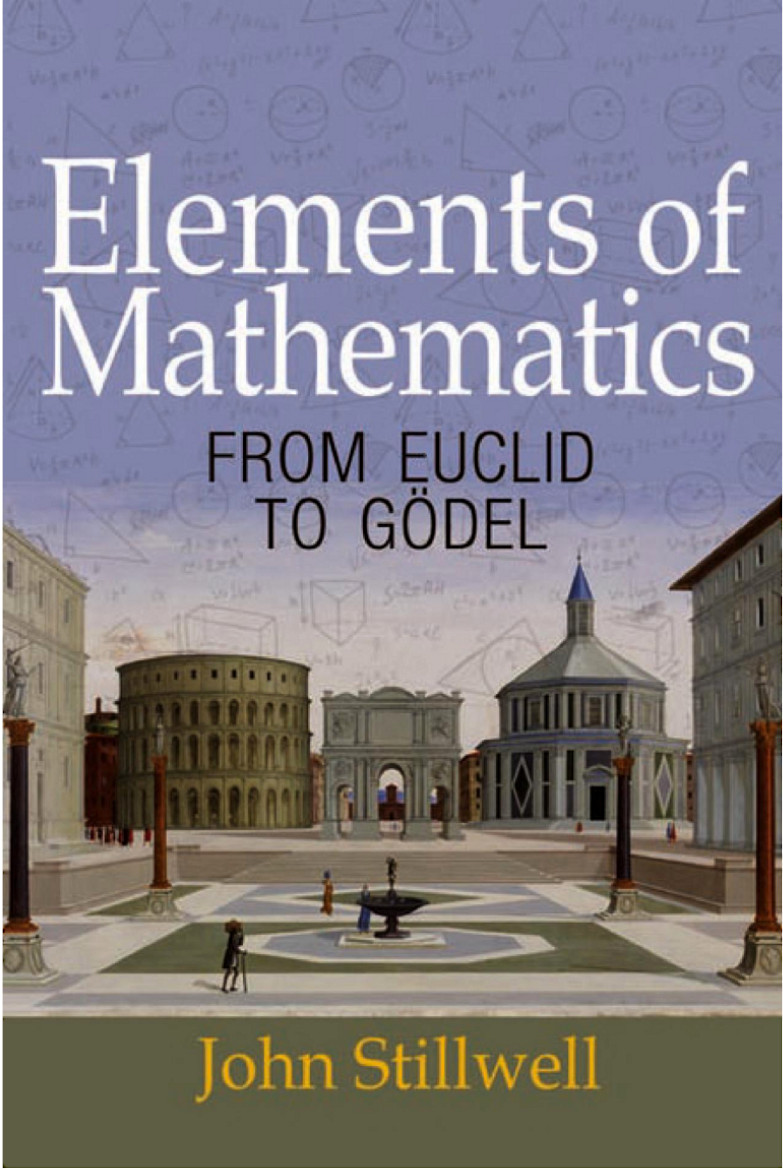
One thing that is very frustrating for students, both in high school and college, is the fact that they never take a course in mathematics. That is, they take programs in geometry, elementary algebra, trigonometry, analysis but they never see to a course that reveals the substantial unity of mathematics as a creation of thought, the many connections between the different branches seemingly far apart, the relationships with other sciences, the applications, the historical and social context. in this respect, Prof. John Stillwell’s books are very useful reading for everyone, and especially for high school and early college students. “Elements of Mathematics,” deals mainly with branches of mathematics already seen in high school, explained in a completely different way, with a new point of view. Each topic is covered clearly, concisely, and succinctly with basic principles, examples, problems, applications and connections to other areas of mathematics, historical notes, and philosophical implications. another volume by the same author, “Mathematics and its History,” which is slightly more advanced, more comprehensive and ponderous (about 660 pages versus 400 in this one), provides an overview of the mathematics one encounters in college; we will discuss this in detail in another post.
This volume aims to celebrate the centenary since the publication of “Elementary Mathematics from a Higher Point of View” (1908), by Felix Klein, and its main thread is to show how not all topics that are part of today’s elementary mathematics have always been considered as such, but have only become so as a result of great mathematical advances and discoveries. It wants to give a bird’s eye view of the discipline from the point of view of a 21st century scientist, in search of the beauty and scope of the subject, and also of its limits. The boundary between “elementary” and “advanced” is the attempt to tame infinity.
The ten sections into which it is divided are:
- Elementary notions (of arithmetic, algebra, geometry, calculus, …)
- Arithmetic (primes, Gaussian integers, continuous fractions, Pell’s equation, …)
- Computational Mathematics (elementary operations, P and NP problems, Turing machines,..)
- Algebra ( rings, fields, vector spaces, …)
- Geometry ( numbers and geometry, Euclidean geometry, geometry of vector spaces,…)
- Calculus ( tangents, derivatives, curve areas, integrals, series, elementary functions,…)
- Combinatorics ( infinity of primes, binomial coefficients, Fermat’s little theorem, graph theory, trees, graphs and planar networks,…)
- Probability ( the player’s downfall, random walks, averages, Bell curve,…)
- Logic (propositional logic, induction, Peano arithmetic, reals, infinity, sets, inverse mathematics, …)
- Some advanced math ( eq. Pell, Turing machine, the fundamental theorem of algebra, the projective line, the Wallis product, ramsey’s theory, de Moivre’s distribution, the completeness theorem,…)
An extensive bibliography concludes the work. The price is very good for the value of the work, about 16€ for the ebook and 20€ for the printed version.
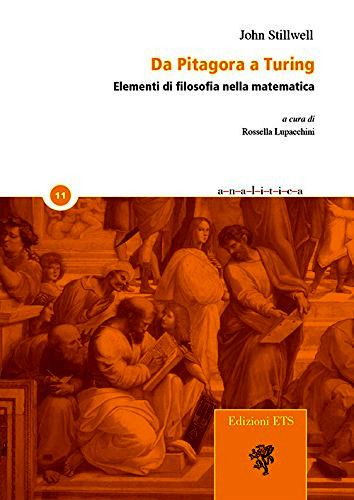
“Elements” of Mathematics is first and foremost a math book, also to be read by doing calculations and solving some problems, although it is not designed as a textbook or textbook, and is not directly useful for passing any exams. For Italian readers denied in the subject, humanists, philosophers, poets, etc., there is another volume, less demanding, less than half the pages long, and with simpler language: “From Pythagoras to Turing: Elements of Philosophy in Mathematics.” (note the “in math,” and not “of math,” which would be another sport). Includes lessons and lectures collected and edited by Rossella Lupacchini, professor of philosophy of science in the Faculty of Humanities at the University of Bologna. I am not aware that there is an English edition; the author rewrote the text specifically for Italian schools. It is therefore also aimed at those who want to learn about the philosophical implications of the subject. as well as, of course, students, mathematicians and science enthusiasts. it is a journey in the more than two millennia separating the discovery of irrational numbers, by the Pythagoreans, from Alan Turing’s rigorous definition of the concept of computable real numbers. Through progressive refinements of conceptual analysis, the gap between numbers and geometry comes to be recomposed in a fruitful dialectical relationship. Stillwell’s intent is to make people reflect on the deep connection between mathematics and philosophy, and to prove the effectiveness of mathematics in defining fundamental philosophical issues: the understanding of infinity; the existence of seemingly impossible concepts, such as irrational and imaginary numbers, points on the horizon, infinitesimals, and non-Euclidean geometry; and the different nature of the concepts of truth and demonstration. From musical harmonies to the science of computers, the culture of the West takes shape from a dual matrix. If Greek mathematics derives its demonstrative character from philosophical speculation, modern philosophy finds its alphabet in the language of mathematics. There are nine key topics, concentrated in about 160 pages that follow the historical evolution of scientific thought:
- Irrational numbers (Pythagoras, Euclid,…)
- Geometry and infinity (Euclid, Thales, Archimedes, Pell,…)
- Imaginary numbers (Cardano, Bombelli, Wessel, Euler, Hamilton, …)
- Geometry and Algebra (Descartes, Grassmann and Peano,…)
- Perspectives (Italian Renaissance art, Pappo and Desargues)
- Infinitesimal calculus (Newton and Leibniz,…)
- Non-Euclidean geometry (Lobacevsky, Bolyai, Riemann, Beltrami, Minkowski, Hilbert, …)
- Real numbers (Dedekind and Cantor,…)
- Computability and demonstration ( Turing and Godel,…) The list price, all things considered reasonable, is €18.
–

John Stillwell is an Australian mathematician, PhD at MIT Boston on Alonzo Church’s team, and professor emeritus at the University of San Francisco (https://www.usfca.edu/faculty/john-stillwell). Author, to say the least, of prolific textbooks and introductory texts on mathematics, among which should be mentioned at least:
- Classical Topology and Combinatorial Group Theory, 1980
- Mathematics and Its History, 1989, 3rd edition 2010
- Geometry of Surfaces, 1992
- Elements of Algebra: Geometry, Numbers, Equations, 1994
- Numbers and Geometry, 1998
- Elements of Number Theory, 2003
- The Four Pillars of Geometry, 2005
- Yearning for the Impossible: The Surprising Truths of Mathematics, 2006
- Naive Lie Theory, 2008
- Roads to Infinity, 2010
- The Real Numbers: An Introduction to Set Theory and Analysis, 2013
- Elements of Mathematics: From Euclid to Gödel, 2016
- Reverse Mathematics: Proofs from the Inside Out, 2018
- A Concise History of Mathematics for Philosophers, 2019
- The Story of Proof: Logic and the History of Mathematics, 2022 Many of these titles can be warmly recommended, for example, “Naive Lie Theory” is an antidote to the excessive abstractness of traditional textbooks on the subject, useful for physicists interested in the continuous symmetries of spacetime. In 2020, the online magazine “Academic Influence” ranked him No. 4 on its list of the ten most influential contemporary mathematicians, “Top Influential Mathematicians Today.”
https://academicinfluence.com/rankings/people/most-influential-mathematicians-today