What is Mathematics
What is Mathematics?
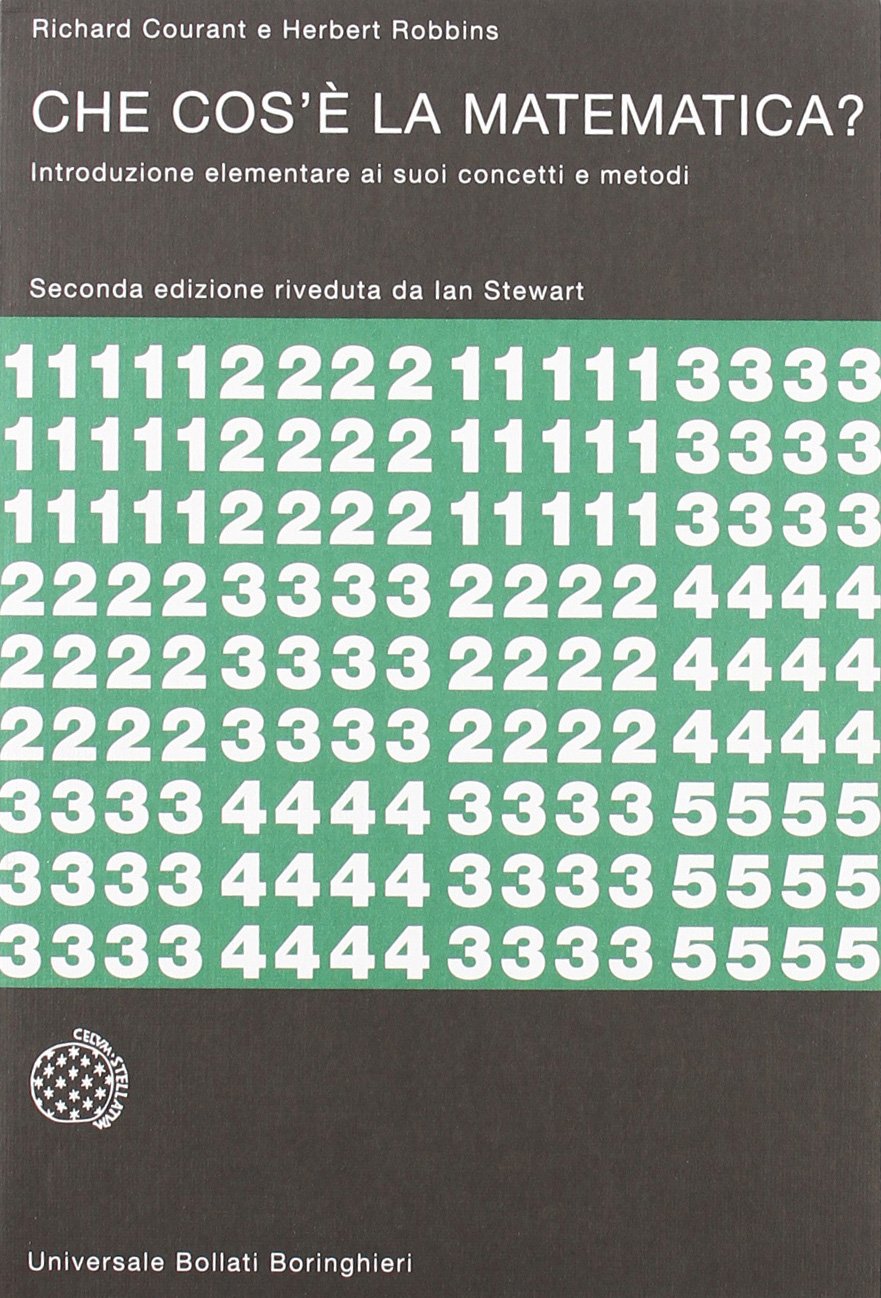
The question deliberately recalls the title of a great classic of high disclosure science, Whats is Mathematics?, published in 1941 by the great mathematician richard Courant with Herbert Robbins, reprinted countless times and revised in 1996 by mathematician and popularizer Ian Stewart. The work is presented as an introductory book to mathematics and its methods, accessible intends to appeal to a very wide audience: college and high school students, secondary school professors, a more general audience of educated and lay people who only studied mathematics in high school, although penetration and understanding of fundamental concepts exposed in the book requires some intellectual effort.
Today for a general introduction to mathematical thinking accessible to a high school or early college student you can certainly recommend John Stillwell’s volume, Mathematics and its History, in the third edition in 2010, with a unified view of the subject in historical and cultural context.
After Mathematics and its History a passionate can try his hand at the Saunders Mac Lane handbook Mathematics, Form and Function. Mac Lane, among the greatest mathematicians of the 20th century, founded with Eilenberg the Theory of Categories, a notion unifying matter even more abstract (and more abstruse for some) of Cantor’s set theory, and drafted with G.Birkhoff a widely used textbook of Algebra. Mathematics, Form and Function is a review of the subject matter which is read with great pleasure even by those who are not at all a pure mathematician, for clarity and depth of thought of the Author.
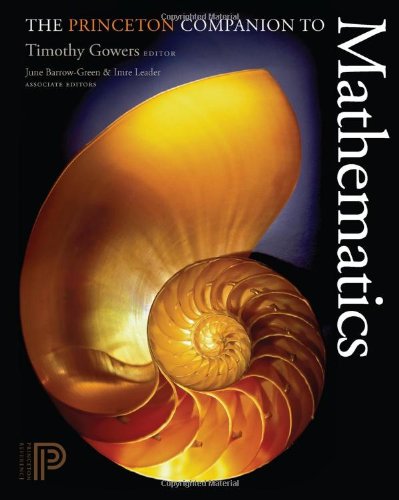
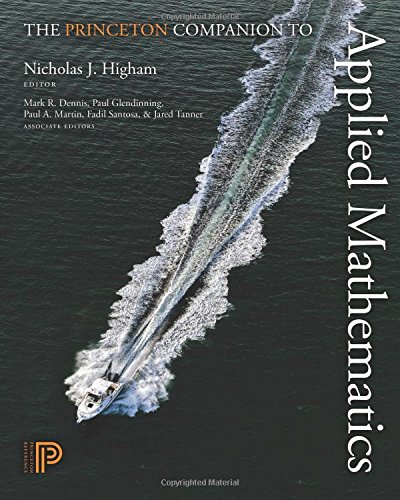
Among reference works of an encyclopedic nature a place two impressive volumes from Princeton University Press deserve special mention, one directed by Tim Gowers for mathematics pure (2008), and the other directed by Nick Ingham for mathematics applied (2015).A true and very up-to-date encyclopedia of mathematical scholarship to which more than three hundred have contributed among the most distinguished specialists in the field, in a massive collective effort.
One possible criticism of Courant and Robbins’ book is that it does not answer the title question, including talking at length about the subject. One answer is the book What Mathematics Really Is, by Reuben Hersh, which focuses on the philosophy of mathematics. Mathematician Hersh criticizes fellow Platonists (mathematical entities exist “somewhere,” you just need to find them) and the formalists (who claim that mathematics has no real meaning, but it is only a manipulation of symbols), and advocates for an interpretation which he calls humanistic-Aristotelian, mathematics is a human activity.
The great Hungarian mathematician Erdös, the man who loved only numbers, believed that “the Supreme Fascist” (God) possessed a Book in which there were mathematical demonstrations in their simplest and most perfect form, and that it was the job of mathematicians to transcribe the pages of that book. Aigner and Ziegler gave us proven in their Proofs from the Book.
An interesting attempt at disclosure is that of Elwes, which tries to explain to the layman in very few words of common language (1001-character limit) all the most fundamental and fascinating concepts of mathematics, including advanced mathematics. The concise definitions cover all areas of pure and applied mathematics.
Instead, Georg Glaeser focuses on applications in science and art of basic mathematics, over 500 in physics, chemistry, biology, astronomy, geography and music.
Manuals such as those of Wallis, Stahl and Johnson, which require nothing more than elementary algebra of secondary school, they can serve to plug holes in secondary preparation and introduce topics of modern mathematics really useful in the real world (probability, statistics, graphs, cryptography, …). They would also be good for “Maths for liberal arts” courses, i.e., math courses for graduates and freshmen in non-science majors (such as arts and philosophy, law, science politics, fine arts … ). See also Lippmann’s volume,Math in Society, and the others mentioned below in “Mathematics for those who do not understand it.”
More specific to students in the first years of science majors is Blinder’s guide, which is useful to correct common errors and gaps in preparation and introduce in a simple and concise manner mathematical tools to take courses in physics, chemistry, engineering, computer science. Even a mathematical methods course such as Nearing’s is useful for this.
At a more advanced level, for those who do not intend to stop at a bachelor’s degree but go on to a master’s or doctoral degree in physics and/or mathematics, there is Garrity’s textbook, which introduces the whole mathematics indispensable to those who want to enroll in an undergraduate/master science degree program. Useful supplement to reading volumes by Mac Lane and Stillwell.
- Richard Courant, Henry Robbins, Ian Stewart - What is Mathematics?, 1941 3rd revised ed. 1996, transl.it. What is mathematics? Elementary introduction to its concepts and methods
- John Stillwell - Mathematics and Its History - 3rd ed(2010)
- Saunders Mac Lane - Mathematics Form and Function- (1986)
- Timothy Gowers - The Princeton Companion to Mathematics
- Nicholas J. Hingham - The Princeton Companion to Applied Mathematics 2015
- Reuben Hersh - What is mathematics, really - (1999) transl. en What mathematics really is
- Martin Aigner, Günter M. Ziegler - Proofs from THE BOOK (2018)
- Richard Elwes - Maths 1001. Absolutely Everything That Matters About Mathematics in 1001 Bite-Sized Explanations (2017)
- Georg Glaeser - Math tools. 500 applications in science and arts (2017)
- W.D. Wallis Mathematics in the Real World (2013)
- Saul Stahl, Paul E. Johnson - Mathematics Old and New (2017)
- Sy M. Blinder - Guide to essential math. A review for physics, chemistry and engineering students- (2013)
- Thomas A. Garrity - All the Math You Missed. (But Need to Know for Graduate School), 2nd ed. (2021)
Articles and online resources: Various theses on the nature of mathematics are examined in the work of Ziegler and Joos. For the great Russian mathematician and physicist Vladimir Arnold, mathematics is part of physics, and should be taught as such, avoiding like the plague abstract and rigorous expositions based on sets and structures in the style of the Bourbaki group. lucio Russo’s article in the same number of Critical Points. Arnold’s article and the relationship between cultural history and exact science discusses Arnold’s essay and the relationship with culture in general. Finally, James Franklin’s article addresses the dichotomy between continuum mathematics and discrete mathematics, increasingly relevant in the computer age in which the latter has become predominant in applications. Always on the discrete-continuous dialectic, with the continuous seen as approximation of the discrete, there is Paolo Zellini’s paper.
Günter M. Ziegler, Andreas Loos - “What is Mathematics” (2017) in: Kaiser G. (eds) Proc. 13th Int.Congress on Math. Education ICME-13 https://doi.org/10.1007/978-3-319-62597-3_5
V.I. Arnold - On the teaching of mathematics, in Uspekhi Matematicheskikh Nauk (1998) English translation Viktor Goryunov, Russian Mathematical Surveys,vol. 53, no. 1, 1998, pp. 229-234, transl.it. Sandro Graffi in CRITICAL POINTS #3 (MAY 2000)
James Franklin - Discrete and Continuous: A Fundamental Dichotomy in Mathematics journal of Humanistic Mathematics 7(2), July 2017 http://dx.doi.org/10.5642/jhummath.201702.18
Paolo Zellini - Discrete and continuous: Story of a mistake, (2022)
Alternatives and further reading
A few years after Courant’s work, in 1956, the following was published in Russian a comprehensive review of the mathematics of the time for the general public, students and people of culture, with contributions of some of the greatest Soviet mathematicians of the time-Kolmogorov, Aleksandrov, Laurentev, Nikolskii, Sobolev, Krilov, Postnikov, Gel’fand and others. A great work in three volumes, of which an excellent and inexpensive english translation, and a very bad partial Italian translation of some of the early chapters.
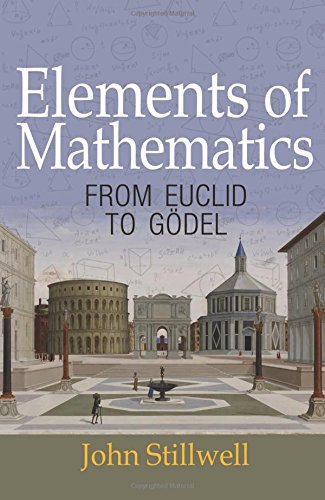
Prof. Stillwell is a very prolific textbook author, by whom should be read a little bit of everything (Four Pillars of Geometry,Naive Lie Theory, Roads to Infinity, Reverse Mathematics,Yearning for the Impossible, Elements of Algebra,Elements of Number Theory, Elements of Mathematics,… ) Those who are passionate about the subject but do not want to read over 600 pages can alternatively limit themselves to Elements of Mathematics from Euclid to Godel, much more manageable.
Linguist George Lakoff, with psychologist Rafael Nuñez, studied the the cognitive science of mathematical ideas. Abstract ideas, for the most part, arise through conceptual-metaphorical metaphor, projecting ideas from the way we operate into the everyday physical world.
To understand how to solve problems, in general, and the nature of mathematical reasoning are always classic texts by Giorgy Polya, especially How to Solve It, the book of most widely read and reprinted mathematics.
- Aleksandrov, Kolmogorov, Laurentev - Mathematics - Its content, methods and meaning.(Vol. 1, 2, 3)
- John Stillwell - Elements of Mathematics From Euclid to Gödel (2016)
- George Lakoff, Rafael E. Nunez - Where Mathematics Comes From. How The Embodied Mind Brings Mathematics Into Being, (2001)
- Gyorg Polya - How to Solve It. A New Aspect of Mathematical Method transl. it. how to solve math problems. logic and heuristics in the mathematical method
- Philip J. Davis, Reuben Hersh - The Mathematical Experience (2000) transl.it. The mathematical experience
- Stewart Shapiro - Thinking About Mathematics. the philosophy of mathematics (2000)
Teaching of mathematics
- Morris Kline - Why Johnny can’t add. the Failure of the New Math
- Paul Lockhart - A Mathematician’s Lament. How School Cheats Us Out of Our Most Fascinating and Imaginative Art Form
- Conrad Wolfram - The Math(s) Fix: An Education Blueprint for the AI Age
- V.I. Arnold - On the teaching of mathematics, cited above
Mathematics for those who do not understand it ( humanists, artists, humanities and social science scholars in general)
Those who think they are denied mathematics, like a philosopher or an artist, can try reading From Pythagoras to Turing, lectures by Stillwell collected in Italian by philosophy teacher Rossella Lupacchini. There is a different, shortened version in English. Still at an elementary level, for a high school student or a man on the street who needs to brush up on those basics, one can also see Arthur Benjamin’s The Magic of Mathematics.
- John Stillwell - From Pythagoras to Turing. elements in the philosophy of mathematics
- John Stillwell - A Concise History of Mathematics for Philosophers (2019)
- Arthur Benjamin - The Magic of Math: Solving for x and Figuring Out Why (2015) transl.it. The magic of mathematics
- Luca Ricolfi - Mathematics for the Humanities (2016)
- Christoper Thomas - Schaum’s Outline of Mathematics for Liberal Arts Majors (2008)
- Morris Kline - Mathematics for the Nonmathematician
- Ian Stewart - Concepts of Modern Mathematics (1995)
- Karl J. Smith - The Nature of Mathematics, 12th Ed (2012)
- Dave Lippman - Math in Society- Ed2.5 (2017)
- Ryan T. White, Archana Tikayat Ray - Practical Discrete Mathematics. discover math principles that fuel algorithms for computer science and machine learning with Python (2021)
- John Vince - Foundation Mathematics for Computer Science. A Visual Approach (2020)
- David J. Hunter - Essentials Of Discrete Mathematics (2015)
History of Mathematics
First quick read a classic, Dirk Jan Struik’s 1948 booklet, repeatedly reprinted.The author spanned three centuries, in fact he was born in Holland in 1894, rose to tenure in 1917 and taught mathematics until 1998, when at the tender age of age 104 retired permanently over 81 years of teaching. He waited until the dawn of the new millennium and passed away two years later in October 2000, at the age of 106. in his long career collaborated with Levi-Civita in Rome, Courant in Göttingen, Norber Wiener at MIT, and took a break from teaching only during the period when he was persecuted in the U.S. by Sen. Mc Carthy. In fact accused of spying for the USSR he was suspended for 5 years from his professorship at MIT, but he did not stop supporting the small Dutch Communist Party and also published works on Marxism. Other undemanding reading is “Taming the Infinite” by tireless popularizer Ian Stewart. For a more thorough modern work, one can consult Victor Katz’s volume, carl Boyer’s new edition of Morris Kline’s monumental work. Odifreddi’s essays and the one by Bartocci and others focus on some themes more and protagonists of 20th century mathematics.
- Dirk Jan Struik - A Concise History of Mathematics
- Ian Stewart - Taming the Infinite The Story of Mathematics from the First Numbers to Chaos Theory transl.it. Taming the Infinite
- Katz, Victor J - A history of mathematics.
- Carl B. Boyer, Uta C. Merzbach - A History of Mathematics, 3 ed.revised transl. it. History of Mathematics (1st ed., not updated)
- Morris Kline - Mathematical Thought from Ancient to Modern Times - 3 vols.
transl.it. history of mathematical thought
- From Antiquity to the Eighteenth Century (Vol. 1)
- From the eighteenth century to the present (Vol. 2)
- Claudio Bartocci and others - Mathematical Lives: Protagonists of the 1900s, from Hilbert to Wiles
- Piergiorgio Odifreddi - The Mathematics of the Twentieth Century
Disclosure for All
- Timothy Gowers - Mathematics. a Very Short Introduction transl. it. mathematics. an introduction.
- Adam Goriely - Applied Mathematics. a Very Short Introduction
- Peter M. Higgins - Numbers. A Very Short Introduction
- Peter M. Higgins - Algebra. a Very Short Introduction
- Edward Kasner, James Newman - Mathematics and the Imagination
- Keith Devlin - Introduction to Mathematical Thinking trad.it. where mathematics goes
- Keith Devlin - The language of mathematics. making the invisible visible transl.it. The language of mathematics. Making the invisible visible
- Otto Toeplitz, Hans Rademacher - The Enjoyment of Mathematics. Selections from Mathematics for the Amateur (1990)
- Eli Maor - Music by the Numbers. from Pythagoras to Schoenberg transl. it. music by numbers. music and mathematics, from Pythagoras to Schoenberg (2019)
- Eli Maor - The Pythagorean Theorem. A 4,000-Year History
Extraordinary Numbers
- John H Conway,Richard Guy - The Book of Numbers transl.it. The Book of Numbers
- Donald Knuth - Surreal Numbers. how Two Ex-Students Turned on to Pure Mathematics and Found Total Happiness transl.en. Surreal numbers. How two former students discovered pure mathematics and found true happiness
- Charles Seife - Zero. the biography of a dangerous idea (2000)
- Petr Beckmann - A History of Pi (1976)
- Peter Greco - History of Pi Greco (2018)
- Eli Maor - e. The story of a number (2015)
- Paul J. Nahin - Dr. Euler’s Fabulous Formula. Cures Many Mathematical Ills (2011)
- Paul J. Nahin - An imaginary tale. the story of the square root of minus one (2016)
- Ian Stewart - Incredible Numbers
- Umberto Bottazzini - Numbers (2018), in the series Telling Mathematics
- Gabriele Lolli - Numbers: The Continuous Creation of Mathematics (2015)
- Constance Reid - From Zero to Infinity. What Makes Numbers Interesting, 15th ed. (2006) transl.it. from zero to infinity. fascination and history of numbers
The Infinite
- Ian Stewart - Infinity. a Very Short Introduction
- Eli Maor - To Infinity and Beyond. A Cultural History of the Infinite (1991) trad.en To infinity and beyond. cultural history of the concept of infinity
- David Foster Wallace - Everything and More: A Compact History of Infinity (2010) transl.it. Everything, and more. compact history of infinity
- Lucio Lombardo Radice - Infinity. philosophical and mathematical itineraries of a basic concept (2014)
- Umberto Bottazzini - The Infinite (2018), in the series Telling Mathematics
- Giorgio Chinnici - The labyrinth of the continuous. numbers, structures, infinities (2019)
Biographies, testimonies and reflections
- Godfrey H. Hardy - Apology of a Mathematician transl.it. Apologia di un matematico
- David Ruelle - The Mathematician’s Brain. transl.it. “The Mathematical Mind”
- Ian Stewart - Letters to a Young Mathematician transl.it. How beautiful is mathematics, Letters to a young friend
- Richard W. Hamming - The Art of Doing Science and Engineering. learning to learn
- Reuben Hersh, Vera John-Steiner - Loving + Hating Mathematics. Challenging the Myths of Mathematical Life
- Serge Lang - The Beauty of Mathematics
- Vladimir Arnold - Yesterday and Long Ago
- Paul Hoffman - The Man Who Loved Only Numbers: The Story of Paul Erdos and the Search for Mathematical Truth (1999) trad.it. The man who only loved numbers
- Sylvia Naser - A Beautiful Mind: The Life of Mathematical Genius and Nobel Laureate John Nash transl.it. The genius of numbers
- Simon Singh - Fermat’s Last Theorem. The adventure of a genius, a mathematical problem and the man who solved it
- Marcus Du Sautoy - The enigma of prime numbers. The Riemann hypothesis, the greatest mystery in mathematics
- Gabriele Lolli - Tables, chairs and beer mugs: David Hilbert and twentieth-century mathematics
- Judith R. Goodstein - The Volterra Chronicles: The Life and Times of an Extraordinary Mathematician transl.it. Vito Volterra. biography of an extraordinary mathematician
- Judith R. Goodstein - Einstein’s Italian Mathematicians translated by I matematici italiani di Albert Einstein. Ricci, Levi-Civita e la nascita della relatività generale
- Fabio Toscano - The genius and the gentleman. Einstein and the Italian mathematician who saved the theory of general relativity
- Cedric Villani - Theoreme Vivant transl.it. The living theorem. my greatest mathematical adventure
- Edward Frenkel - Love and Math: The Heart of Hidden Reality (2014)
- Jeremy Gray - Simply Riemann (2020)
Other Readings
History of Mathematics
- Eric T. Bell - Men of Mathematics (1986) transl.it. The great mathematicians
- Ian Stewart - Significant Figures: The Lives and Work of Great Mathematicians transl.it. The Number Ones. The Lives of the World’s Greatest Mathematicians (2018)
- Jane Muir - Of Men and Numbers: The Story of the Great Mathematicians
- Frank J. Swetz - The Search for Certainty: A Journey Through the History of Mathematics, 1800-2000
- Jacqueline Stedall - The History of Mathematics. a very short introduction
- Umberto Bottazzini - Hilbert’s Flute. history of mathematics
- Bruno D’Amore, Silvia Sbaragli - Mathematics and its history - 4 vols. 1. From origins to Greek miracle 2. From the Greek sunset to the Middle Ages 3. From the Renaissance to the 18th century 4. From the 18th to the 21st century
For the history of science in general from 1600 onward, not restricted to just math, is always useful consult the monumental work in 6 vols. edited by Paolo Rossi
- Paolo Rossi (editor) - History of modern and contemporary science - 6 vols. 1.1 From the scientific revolution to the Age of Enlightenment I 1.2 From the Scientific Revolution to the Age of Enlightenment II 2.1 From the Romantic Age to Industrial Society I 2.2 From the Romantic Age to Industrial Society II 3.1 The twentieth century I 3.2 The Twentieth Century II