Science and Development
The fundamental role of basic scientific research
Advances in theoretical physics such as quantum mechanics, electromagnetism, atomic and nuclear physics, and condensed matter physics have revolutionized the 20th century, with their enormous impact on technology, industry, economics and society, the practical applications affecting our daily lives.
It can be said without any doubt that a very large part of our well-being and wealth comes from basic scientific research, for the sheer love of knowledge, without any profit motive or direct application.
---
config:
  theme: forest
  look: classic
---
graph LR
A[Ricerca <br /> di base] --> B(Bacino di <br />conoscenza)
B --> C[Ricerca <br /> applicata]
C --> D[Ricerca <br /> industriale]
D --> E[Nuove <br /> tecnologie]
E --> F[Produttività]
E --> G[Crescita <br /> economica]
E --> H[Benessere <br /> sociale]
In fact, all great technological advances, and thus growth in productivity and wealth, are the long-term effect of fundamental research, such as the theory of electromagnetism in the late 1800s and quantum theories in the early 1900s. Computers, the Internet, GPS, magnetic resonance imaging, lasers, touchscreens derive from decades of fundamental research, in publicly funded theoretical physics, often without immediate commercial applications. The same for biotechnology, fertilizers, herbicides, and drugs that derive from lengthy research in chemistry, biology, and genetics.
The tree of innovation
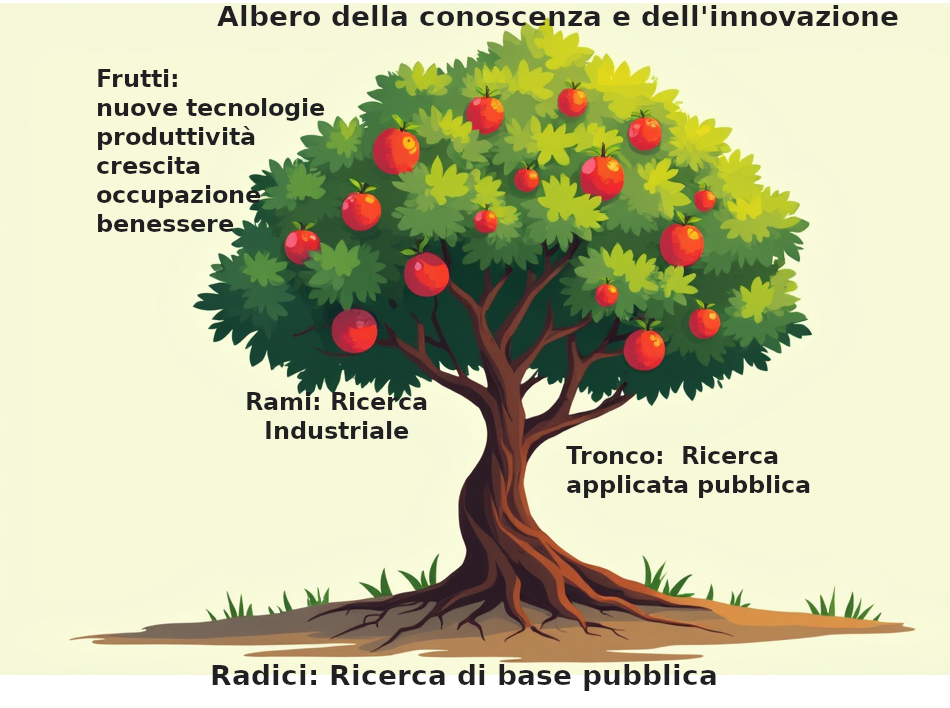
Innovation is like a tree, in which basic research is the roots, applied research forms the branches, practical applications and new products used by all are the fruits.
- Basic research creates a “knowledge pool” that expands technological possibilities
- Knowledge is gradually transformed into technology, first through applied research, and then in industrial research
- New technologies generate productivity, economic growth and social welfare
Unfortunately, the trend today is to fund only industrial research, involving private companies in decision-making and exploitation through patents of knowledge, cutting public funds for pure basic research, with disastrous long-term results for society and all of humanity.
You basically try to produce fruit from the tree of innovation by drying up its roots.
Indeed, Nobel laureate Carlo Rubbia1 warned, speaking of our country’s drift:
_“Research institutions want to do only applied research, increasingly mortifying basic research.But basic research is comparable to the roots of a tree: if you want fruit, you have to nurture the roots.In Italy, however, the roots are being cut off.So what fruit do you think that tree will be able to produce tomorrow?”
For another Nobel laureate, among the greatest theoretical physicists of the century, Sheldon Glashow: “If Faraday, Roentgen, and Hertz had focused on the ‘real problems’ of their day, we would never have developed electric motors, X-rays, and radio. It is true that physicists working in fundamental research deal with ’exotic’ phenomena that are not in themselves particularly useful. It is also true that this kind of research is expensive. Nevertheless, I would argue that their work continues to have an enormous impact on our lives. In truth, the search for fundamental knowledge, driven by human curiosity, is just as important as the search for solutions to specific practical problems.”2
Ideas can be used by many simultaneously (“non-rivalry “): “If you have an apple, and I have an apple, and we exchange them, then you and I always have one apple each. But if you have an idea, and I have an idea, and we exchange them, then we both have two ideas.”3 When knowledge is shared the results of research benefit everyone indistinctly (“difficult excludability “).
For this research, knowledge, knowledge:
discourage private investment that aspires to certain returns
conflict with private property and economic freedom (patents, copyrights, …)
they languish in authoritarian political regimes, which hinder the free flow of ideas
barely survive in societies where economic security, incentives, recognition and rewards for researchers, scholarships and adequate funds for research are not recognized. by their nature, they are public and democratic goods par excellence, assets of the community, flourishing in a state that adequately rewards students and researchers, invests a large part of its GDP in advanced education and scientific progress. basic research is characterized by:
public and state funding, large and long-term (“patient” capital) 4
very long time horizons, from 30,50 to 100 years and beyond
total uncertainty, very high risks of no return on investment
absolute unpredictability of results and possible fields of application
total sharing, and completely free of charge, of every result and knowledge gained, among all the scientists of the world
---
config:
  theme: forest
  look: classic
---
graph TD
    A[Ricerca di base]
    B[Finanziamento <br /> pubblico]
    B --> E[Tempi <br /> Lunghissimi]
    B --> H[Incertezza <br /> totale]
    B --> I[Altissimi <br /> rischi]
    B --> J[risultati <br /> imprevedibili]
    B --> K[applicazioni <br />  imprevedibili]
    B --> L[Condivisione <br /> gratuita]
    E --> A
    H --> A
    I --> A
    J --> A
    K --> A
    L --> A
A sovereign state finances itself for these large investments by printing money at a level where it maintains control over inflation, issuing government bonds purchased in the primary market by a central bank, causing moderate inflation to stimulate investment and employment, adequately purging creditors and savers, and exploiting increased tax revenues for long-term growth induced by technological development.
The sciences bring general benefits rather than specific benefits to certain products of some industry. It is only in the latter stages, when the important results have been obtained, 95 percent of the result has already been achieved, and only the details for technological implementations are missing, that private capital comes into play, financing industrial research, and caging it with patents and intellectual property rights.
They often use “venture capital” that accepts great risks and uses leverage, that is, funds derived from borrowing dozens of times more than the collateral provided, collateral that generally consists of junk securities or stocks deposited in a tax haven by a hedge fund. In this way the private sector (companies, , entrepreneurs, executives, professionals, investors, savers, …) can rob the community of the knowledge and wealth created by public spending, in pure research, applied research and higher education. A shameful “socialization of risks and privatization of profits “.
In the last stage of technological development and business applications, the gains in productivity that generate wealth are achieved, in any economic development model:
- technological progress is not an external factor but endogenous (internal) to the economic system (Paul Romer, Nobel Prize 2018).5
- investments in research and development, human capital and innovation generate increasing economic returns
- scientific research is the key driver of long-term economic growth and general welfare in society
In fact, long-term economic growth is caused primarily by improvements in productivity (ratio of value produced to expenditure to produce it, per hour): “productivity is not everything, but in the long run it is almost everything, “ (Paul Krugman, 2008 Nobel Laureate)
The world is much richer today than it was 100 or 200 years ago not because of capital or better-educated entrepreneurs and workers, but only because of technological innovations, with which we can produce more and better quality goods with the same amount of inputs, indeed at much lower cost.
A century ago it took a craftsman (cobbler) at least three months to make a pair of boots, and they cost six months of the average salary; today in an automated Chinese factory the machines produce ten thousand boots a day at a cost a thousand times less.
Things like working longer hours, working hard and strenuously, with commitment and sacrifice, i.e., “the slave mentality in a modern world that does not need slaves “ denounced by philosopher Bertrand Russell in “In Praise of Idleness “ count for nothing in hourly productivity. The investment of entrepreneurs and savers also counts for very little when they exploit the work of others not to innovate and make too much money compared to their contribution. He or she can become richer who works less if he or she is more educated (STEM graduate), and knows how to use technological innovations better than the illiterate, high school graduate or graduate in the humanities subculture.
Major increases in productivity come from technological revolutions, which in turn come from scientific knowledge, from advances in basic research.
The combination of ideas and economic goods generates true wealth: “Firms do not need to reinvent the computer idea every time a computer factory is built. The same detailed set of instructions for assembling a computer can be used in every new factory because it is a nonrivalrous good. If the returns to scale are constant for rival inputs (factories, workers, and materials), the set of rival inputs and ideas has increasing returns to scale: if you double the rival inputs and the quality or quantity of ideas, total output will increase more than proportionately. “6
Despite the obvious contradiction of the functioning of capitalism, markets and private property with the public good nature of knowledge and science, and with prices under free competition, economic growth and technological development have been concentrated mainly in advanced Western countries.
Countries of so-called “real socialism” or “Asian Marxism” led by the former USSR failed to produce wealth for distribution until their collapse around 1990. Due to the inability to efficiently manage a planned economy before the Internet boom of the turn of the century. That is, without today’s technologies to handle large amounts of data with powerful computers, high-speed communication networks, and artificial intelligence algorithms, it was impossible to centrally source and manage all the necessary information and develop the ability to reward improvements in productivity and efficiency with incentives.
When China adopted a hybrid model, which they call “socialism with Chinese characteristics,” with huge state investment in the latest science and technology, it began to grow unabated, lifting more than 800 million people out of absolute poverty.
To explain capitalist economic progress in the U.S. , Europe, Japan and South Korea, liberalist economists have developed models of “imperfect competition” in which firms innovate because they are able to limit the use of their ideas by keeping them secret or protecting them with patents, altering prices and access to markets.
In this way (secrecy, patents, rights):
- inefficiencies are introduced into the economy, bringing the price of ideas above their marginal cost, contradicting the law of supply and demand in liberal economics,
- you harm scientific research and technological development, which need the free sharing of ideas and information to grow and achieve results
But it is the price to be paid for having more innovation and growth in capitalist systems, attracting private investment in the absence of sufficient public investment is how innovative firms gain the largest market shares.
A system that works up to a point, so much so that states and individuals sponsor, for example, opensource (development of open source code, often free) otherwise innovation in computing would come to a standstill.
The eventual economic return of long-term research funded by all citizens should never go to a single company or entrepreneur.
The key role is always played by the state, which:
- legislates the system of patents and intellectual property rights
- stimulates innovation with business aid and tax benefits
- invests in higher education and training by promoting the accumulation of knowledge
- leaves some freedom to the academic sector and autonomous research organizations
- very long-term, high-risk investment in basic research
Theories of economic growth and the role of basic research
Modern theories of economic growth point out that sustainable technological development depends crucially on the funding of public fundamental research. This process can be likened to nurturing the roots of a tree to produce abundant fruit.
The theoretical foundation
Romer’s endogenous growth theory revolutionized the understanding of economic development by showing that technological innovation is not an external factor but is generated within the economic system through intentional investment in knowledge creation. Basic research represents the “roots” of the innovation tree:
- Public good: Fundamental knowledge has characteristics of public good (non-rivalry, difficult excludability) that discourages appropriate private investment
- Uncertainty and time horizon: Basic research involves high risks and long time frames that the private market tends to avoid
- Positive externalities: Benefits of fundamental research spread throughout the economy in unpredictable ways
The innovation cycle
Just as a tree transforms nutrients absorbed by its roots into fruit, the innovation ecosystem transforms fundamental research into practical applications:
- Basic research creates a “knowledge pool” that expands technological possibilities
- This knowledge is gradually transformed into application technologies through industrial R&D
- New technologies generate productivity, economic growth and social welfare
Historical cases confirm this pattern: the Internet, GPS, MRI, lasers, touchscreens, and many biotechnologies are derived from decades of publicly funded fundamental research, often without immediate commercial applications.
Mazzucato’s paradigm
Mazzucato’s “innovator state” model reinforces this view, demonstrating that major technological revolutions have been made possible by patient, mission-driven public investments that have “nurtured the roots” of innovation. These investments have created fertile ecosystems where private companies have subsequently been able to develop commercial applications.
Just as a tree cannot produce fruit without healthy and well-nourished roots, an economy cannot generate sustainable innovation without adequate investment in fundamental research that expands the boundaries of human knowledge.
The model of the innovative state by Mariana Mazzucato
The model proposed by Mariana Mazzucato, an Italian-American economist, challenges the conventional view of the state’s role in technological innovation. According to Mazzucato:
- The state is not just a passive facilitator of private innovation, but a key player that takes risks and invests in long-term fundamental research
- Many revolutionary technologies (the Internet, GPS, touchscreens, search algorithms, lithium batteries) have arisen from substantial public funding and patient
- Private and venture capital tend to enter only at later stages, when the major risks have already been absorbed by the public sector
- The state has a unique ability to fund “mission-oriented” research with long time horizons and high uncertainty
- There is a “risk socialization and profit privatization” problem when companies benefit from publicly funded innovations without adequate returns to the state
Mazzucato argues that recognizing this active role of the state is critical to building effective innovation ecosystems and ensuring that the benefits of innovation are more equitably distributed.
Paul Romer’s endogenous growth model
Paul Romer, 2018 Nobel laureate in economics, developed the endogenous growth theory that:
- Positions technological progress as endogenous (internal) to the economic system, not as an external factor
- Considers ideas as “non-rival” assets that can be used by many at the same time
- Identifies knowledge as a key driver of long-term economic growth
- Argues that investments in research and development, human capital, and innovation generate increasing returns
- Recognizes the importance of intellectual property rights in fostering innovation
According to Romer, technological innovation creates positive externalities that benefit the entire economy. Policies that promote knowledge accumulation (education, R&D, balanced intellectual property protection) are therefore crucial for sustainable economic growth.
Both models emphasize the critical importance of long-term investment in research and development, although Mazzucato emphasizes more the direct role of the state in taking pioneering risks that the private sector often avoids.
Intervista citata in Scienza in Rete:
https://www.scienzainrete.it/italia150/carlo-rubbia ↩︎[L’importanza scientifica e tecnologica della fisica delle particelle]PROTECT_URL_4 , Parigi 4 ottobre 2002, trad.it. Prof. Guido Martinelli. ↩︎
Attribuita a G.B.Shaw ↩︎
Mariana Mazzucato, “Lo stato innovatore”, (2013) ↩︎
Paul Romer, “Increasing Returns and Long Run Growth” (1986). ↩︎
Chad Jones, “The Facts of Economic Growth”,(2015) ↩︎