The political economy that moves and regulates the world-Part II
DRAFT - WORK IN PROGRES …
Foreword
Scholars such as Albert Hirschmann (American naturalized German liberal economist and philosopher, brother-in-law of Altiero Spinelli, and father-in-law of 1998 Nobel laureate Amyarta Sen) analyzed the laws and mathematical models proposed by liberalist economists as Freudian envy of Physics (in analogy with the trauma of penis envy in girls). As noted by Hirschmann, if a scientist sees a wiggling dog the tail, for a liberal economist it is the tail that wags the dog. In 1987, a major interdisciplinary conference, at which major economists, social scientists and theoretical physicists from the U.S. and around the world, including several Nobel laureates, should have initiated the study of the Economy as a complex system. The Santa Fe conference was chaired by physicist Philip W. Anderson, founder of complex systems theory emerging (“More is different” Science, 1972) and Nobel Prize winner in 1977, together with David Pines (theoretical physicist) and Kenneth Arrow (economist, 1972 Nobel laureate). After listening to the economists’ report on the status of their subject, increasingly horrified and disgusted by the absurd assumptions, Anderson asked: _But do you guys really believe this crap?
The idea that markets naturally tend toward equilibrium, as if pushed by an invisible hand, thanks to the information provided by prices, is based on clearly ridiculous assumptions:
The interactions between economic agents are very simple. They are actually very complex and drive chaotic behavior, or to converge to situations far from ideal ones (example high unemployment and degrowth.) The correlation between many agents leads to instability and continuous crises.
Economic agents have infinite intelligence and they have rational expectations.That is, they use information in a way that is efficient without making systematic errors in predicting the future state of the economy.In reality, economic agents behave in a manner irrational, have little information, which they do not know how to use and they make them wrong.
information is endless and available. In reality, information is often not shared between economic agents (seller/buyer, insurer/insured), those who have more information benefit. In this case we speak of information asymmetry, which leads to to adverse selection, moral hazard and market failure. The classic example is the used car market. The actual condition of the car is known only to the seller.An average price is set, too high for cars in poor condition and too low for cars in good condition.So good cars are expelled from the free market where only the bad ones, the bins, remain.
Companies work under perfect competition.In reality monopolies and oligopolies form, not necessarily bad for growth and development (see, e.g., Paolo Sylos Labini, “Oligopoly and Technical Progress”). Companies that are strategic to a country, especially in the service sector, often operate under a natural monopoly, in which only one enterprise can exist in the market (example networks and infrastructure for the distribution of water, gas, electricity, highway and rail network).
Moreover, in classical liberal economics, the following are not considered so-called externalities, which they cannot put a price on:
the costs of unsustainable consumption of natural resources, pollution caused by corporations, global warming, consumption indiscriminate use of common property over which property rights are unclear, such as water or air, scientific and technological knowledge accumulated in society, the cost of excessive inequality and precarity caused by the market.
the benefits for growth and labor productivity of scientific research, technological progress, of innovation for long-term investment by the state, of process and product innovation.
The old adage applies perfectly to the liberal economist by Oscar Wilde: knows the price of everything but the value of nothing.
Both the founders of the discipline in the early nineteenth century (Adam Smith, Ricardo, Marx) that the great economists of the 20th century (John M. Keynes, Joseph Schumpeter, Piero Sraffa above all, but also Karl Polanyi, Hyman Minsky, Thorstein Veblen, Michael Kalecki, Nicholas Kaldor, Nicholas Georgescu-Roengen, …) were very clear about the limits of their discipline and the close connection with history, sociology, anthropology, ethics, philosophy. And today there are many schools of economists heterodox who are refounding the discipline on a firmer foundation. Many contemporary economists are engaged in the study of the market failures, causing inefficiency, unemployment, stagnation. Some market failures are related to asymmetric information (Akerlof, Spence, Stiglitz, …). Others study the bounded rationality or irrationality of economic agents with behavioral psychology ( Kahneman, Tversky, Simon, Shiller, Thaler,…). Finally, some develop more realistic models of economic systems, incorporating advances in theoretical physics of complex systems, in the field of ‘Ecophysics. Therefore, it takes a lot of nerve and bad faith to support the argument that you need to liberalize markets, privatize and reduce state intervention, dirigisme and planning. Businesses for example do not pay back the pollution they produce, cannot respond to challenges such as those of a pandemic, are unable to provide public goods including basic research, education, health care, to limit inequality within socially acceptable limits to make countercyclical policies in times of deep crisis. In essence, the state must reach where by nature businesses do not reach. Unfortunately, companies often take advantage of this, and continually demand aid, public funds, tax cuts, to the point that writer Gore Vidal once said that our economic system is free enterprise for the poor and socialism for the rich.
The following list of suggested readings I hope you might use to inform yourself and fill their own lacumas.
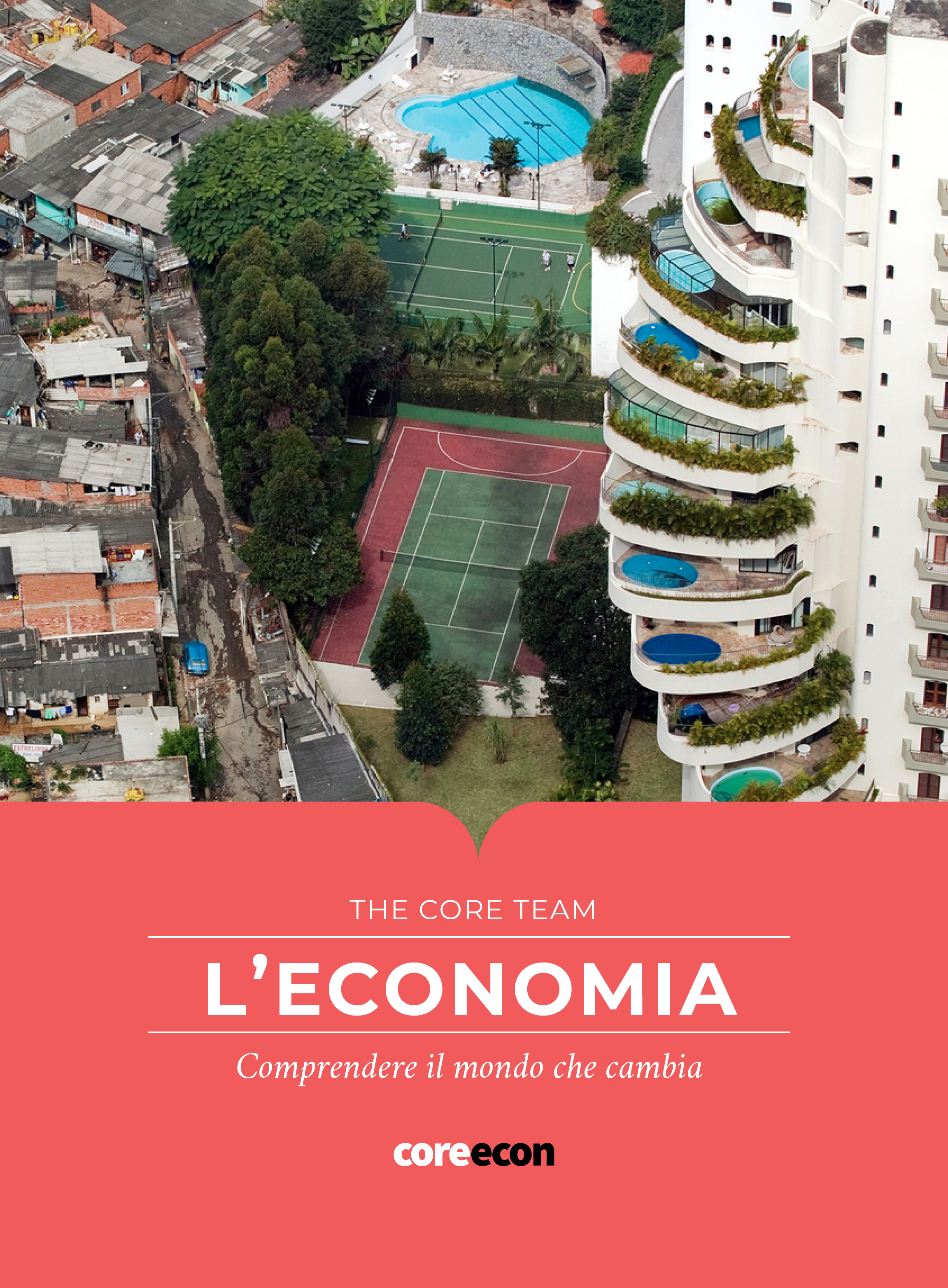
For a comprehensive college-level textbook the one to recommend is the CORE Book inspired by Sam Bowles, available free online on the Internet: L’Economia
(the printed Italian edition is only partial, poorly translated and expensive).
Historical introductions to economic thought
- Alessandro Roncaglia, Paolo Sylos Labini - Economic thought. themes and protagonists.
The contemporary debate on crises, the failure of dominant theories and the future of the world economy:
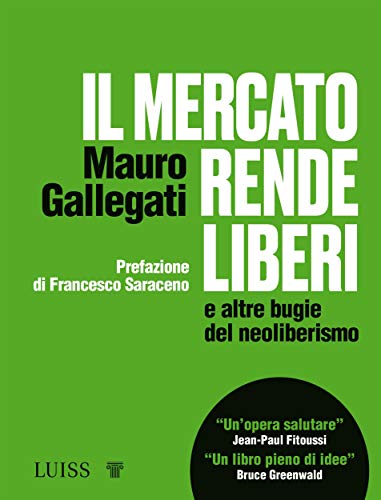
Mauro Gallegati - The market makes you free and other lies of neoliberalism
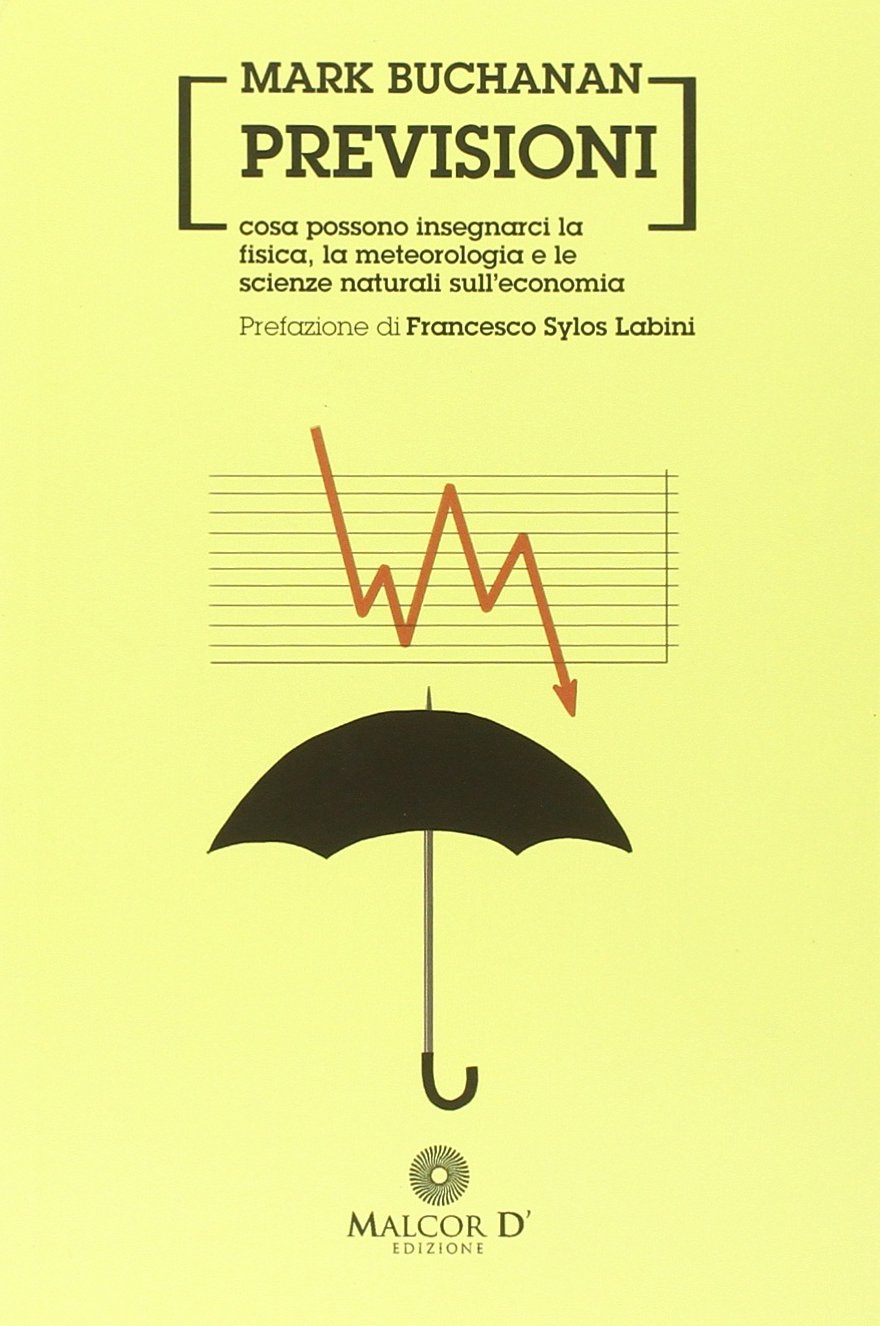
Mark Buchanan - Predictions: What physics, meteorology and the natural sciences can teach us about economics
UPDATE (12/2023) Other books that could be included in this list:
Clara E. Mattei - L economics is political: Everything we see about the economy and no one tells (2023)
Mariana Mazzuccato - Mission Economics. A guide to changing capitalism (2021)
Michele Alacevich, Anna Soci - Brief History of Inequality (2019)
Francesco Saraceno - Beyond Central Banks. Inflation, Inequality and Economic Policies (2023)
University textbooks:
- The Core Team L’Economia Free online course in political economy - https://www.core-econ.org/the-economy/it/
Mauro Gallegati - The market makes you free
and other lies of neoliberalism LUISS University Press, 2021
“The market makes free” is the perfect antidote to the temptation of simplification that has done so much damage and continues to do in public debate. There is still a long way to go, as Mauro Gallegati himself shows us in this book, however, progress has been remarkable in the very fields that have proved most relevant in recent years, from models of financial instability and crises to theories of innovation and technical progress, to name only the most obvious. Of course, the theory is not yet established, but this does not justify the persistence of policies and methods of analysis whose credibility has been definitely called into question by the events of the past ten to fifteen years. it is important to read Mauro Gallegati’s book today and will be even more so when the crisis of our time is behind us and the temptation to return to business as usual will have to be resisted. (from the introductory essay For an Economy of Complexity by Francesco Saraceno, which alone would be worth reading the book)
With his usual rigor and irony, Mauro Gallegati returns in his latest book to debunk one of the myths of the our time: the market makes free. It does so through a pars destruens that shows the logical inconsistencies and the theoretical weaknesses of the marginalist axiomatic approach-which is still dominant in the discipline of economics today and a pars construens describing the theoretical and modeling approach of Complex Adaptive Systems (SAC), developed in recent years and considered most suitable for studying the functioning of contemporary economic systems. Critique of the dominant modeling and theoretical framework Blind faith in the functioning of the market as described by the axioms underlying economic models marginalist framework, has turned economics into a useless science, incapable - by construction - of describing the dynamic functioning of contemporary economies and especially to explain the crises that in recent decades have plagued the societies in which we live. … The theoretical difficulties are compounded by the harsh clash with factual reality. The marginalist framework, both in its neoclassical version than in the neo-Keynesian version, cannot in fact represent or contemplate - by construction - some of the phenomena that characterize the dynamics of contemporary capitalist systems such as, for example, the distributive conflict between classes described by the classics and Marx, the inherent financial instability theorized by Hyman Minsky, strong uncertainty and effective demand at the heart of John Maynard Keynes’ work, o the evolutionary nature of the process of technological innovation as theorized by Joseph Schumpeter and his successors. … Complexity as a new theoretical paradigm Complexity theory makes a radical paradigm shift in epistemological terms from marginalist reductionism, proposing an alternative theoretical approach that can include within it-as much as is possible for a social science those theoretical components necessary to describe the reality around us. (from a review by Lucrezia Fanti)
Prof. Mauro Gallegati teaches “Advanced Macroeconomics” at Univ. Politecnica delle Marche. In his research on asymmetric information in markets collaborated with J.Stiglitz (Nobel Laureate) and Bruce Greenwald.
- Book Details https://luissuniversitypress.it/pubblicazioni/il-mercato-rende-liberi/
- In economics, faith matters more than science, review by C.Clericetti https://www.micromega.net/in-economia-conta-piu-la-fede-che-la-scienza/
- All the lies of neoliberalism, review by L. Fanti https://sbilanciamoci.info/tutte-le-bugie-del-neoliberism
- Does the market make you free?, review by S.Lucarelli https://www.kriticaeconomica.com/insegnare-teoria-economica-gallegati/
- Giovanni Dosi, Mauro Gallegati - A toolbox to rethink https://www.ilsole24ore.com/art/una-cassetta-attrezzi-ripensare-AEOt5b0C
- Neoclassical economics? A pseudoscience, interview with Francesco Sylos Labini https://www.sinistrainrete.info/teoria-economica/7492-francesco-sylos-labini-l-economia-neoclassica-una-pseudoscienza.html
Mark Buchanan - Forecast
What physics, meteorology and natural sciences can teach us about economics
Being able to predict financial bad weather, as we are now able to do with hurricanes and storms, may remain only a dream; however, scientific theories used for forecasting in meteorology and earthquake prevention in geology, when applied to the analysis of the economic system, can offer a shelter from the turbulence that cyclically hits on today’s capitalist system.The financial collapse of 2008 not only undermined the foundations of the world economic system, but it also enshrined the crisis of hitherto dominant economic thinking. The concepts of market stability and efficiency were disregarded from the effects of the very mechanisms that were supposed to ensure their implementation. Derivatives, leverage, hedge funds, high-frequency exchanges, contrary to the predictions of equilibrium economic theory, contributed instead, at the time of the crisis, to amplify the negative results of stock market crashes. In telling the economic story of recent years, Mark Buchanan conveys a new way of thinking that could revolutionize economic policy choices. From the foreword by Francesco Sylos Labini (CREF physicist, son of economist Paolo Sylos Labini):
L’economia neoclassica è oggigiorno fornita di una veste matematica, quasi fosse una scienza naturale, ma non è capace di descrivere la realtà come il fallimento di ogni previsione mette chiaramente in luce: per rimediare si racconta, ovviamente a posteriori, che i fallimenti sono dovuti a shock esterni (ad esempio le crisi politiche, i terremoti, ecc.) che non sono contemplati dai modelli. Eppure il confronto con la realtà è la forza del metodo scientifico che seleziona le teorie valide proprio in base al successo nella previsione. In fisica, ad esempio, si possono trovare tanti esempi di teorie matematicamente corrette ma del tutto irrilevanti poiché basate su ipotesi errate: dunque queste teorie portano a risultati contraddetti dagli esperimenti. Ma se un esperimento è in disaccordo con la teoria non si conclude che questo discredita il metodo quantitativo quanto piuttosto si ragiona sulle ipotesi su cui è basato il modello e si identificano quali sono quelle sbagliate. E ovviamente si cambia mo
…
An economic theory that does not consider the way in which collective behaviors of agents or sensitive dependence on small perturbations arise–as precisely neoclassical economics does–cannot claim to explain how the major crises or sudden and abrupt fluctuations that are observed daily in financial markets occur. The idea that an interconnected and closely interdependent system such as the modern financial economy, can strive for some form of stability, must be questioned in a lay to pragmatic manner.
- Preface to Previsions by Francesco Sylos Labini https://francescosyloslabini.info/2021/11/25/prefazione-al-libro-previsioni-di-mark-buchanan/
- Is economics a hard science? https://www.ilfattoquotidiano.it/2011/07/07/leconomia-una-scienza-dura/143752/
- Is economics an exact science? https://www.syloslabini.info/online/leconomia-e-una-scienza-esatta/
- The science of cargo worship https://www.syloslabini.info/online/la-scienza-del-culto-dei-cargo/
- Physics and economics from Newton to complex systems https://www.roars.it/online/fisica-ed-economia-da-newton-ai-sistemi-complessi/
- Jean-Philippe Bouchaud (CFM) - Economics need a scientific revolution https://arxiv.org/abs/0810.5306 (2008)
- Jean-Philippe Bouchaud - The (unfortunate) complexity of the economy https://arxiv.org/abs/0904.0805 (2009)
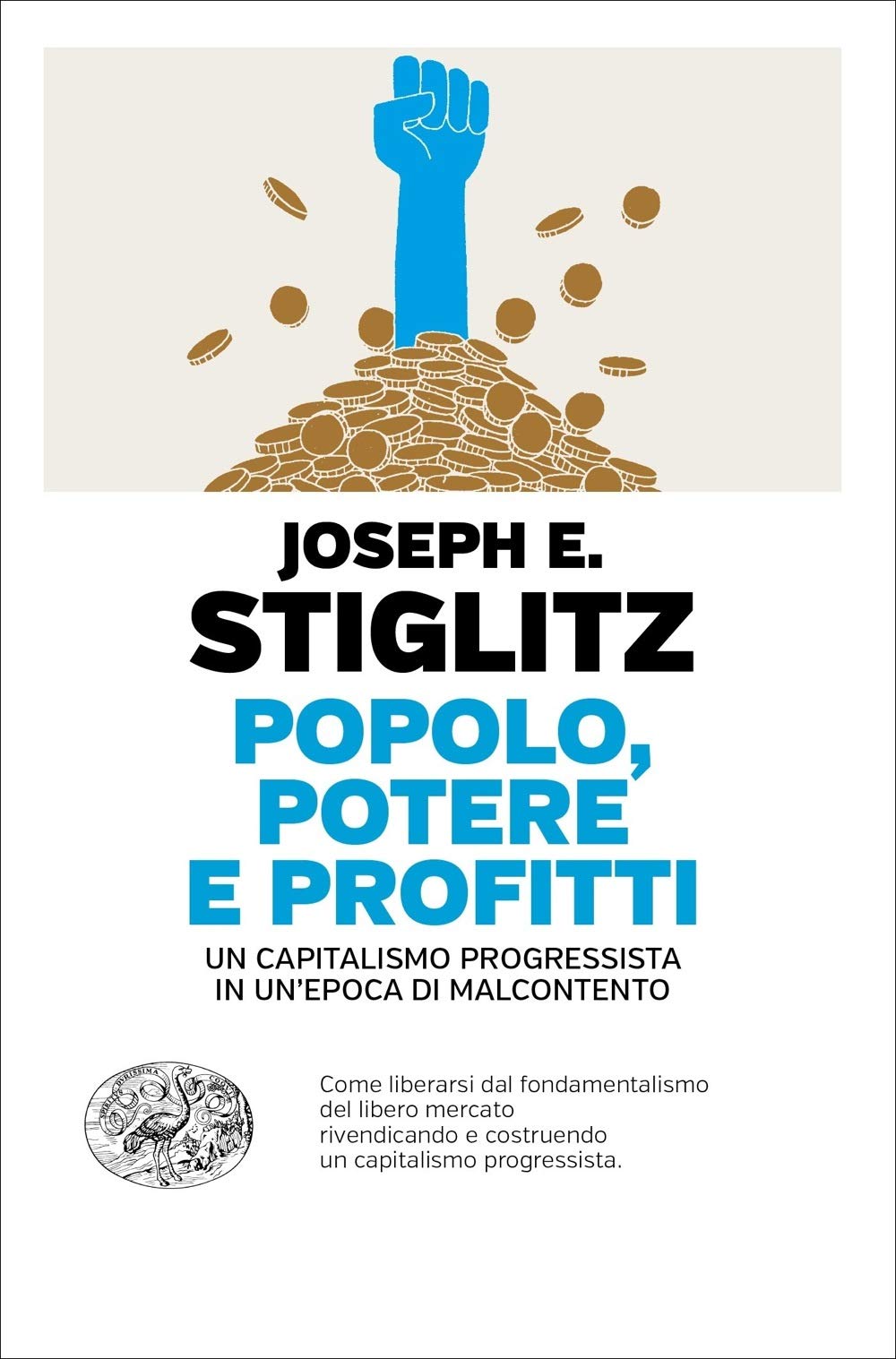
Joseph Stiglitz - People, power and profits
A progressive capitalism in an age of discontent
The consolidation of market power especially in finance and the technology industry has led to an explosion of inequality. the situation is dramatic: a few corporations dominate entire sectors of the economy, causing inequality to soar and slowing growth.Finance has written its own rules; high-tech companies have hoarded personal data unchecked, and the U.S. government has negotiated trade agreements that do not represent the interests of workers. too many people have grown rich by exploiting others instead of creating wealth. The real sources of wealth and growth, for Stiglitz, are living standards, based on learning, progress of science and technology and the rules of law. The attacks on the judicial system, university and communications harm the very institutions that have always founded economic power and democracy. however, as helpless as we may feel today, we are not, all of us, powerless.In fact, economic solutions are often clear. We must harness the benefits of the market but at the same time tame its excesses, ensuring that they work for us citizens - and not against us. If enough people support the agenda for change outlined in this book, it may not be too late to create progressive capitalism that realizes shared prosperity.
Nobel laureate (2001) Joseph Stiglitz served as vice president of the World Bank, economic adviser to President Clinton and professor at Yale, Stanford and Princeton universities, before to move to Columbia (New York) where he holds the chair of Political Economy. Famous for his studies on how asymmetric information causes markets to fail, unemployment and credit rationing.
Alessandro Roncaglia, Paolo Sylos Labini - Economic Thought
Themes and protagonists
Laterza, 2nd ed. (2002), 126 pg.
A very simple yet authoritative introduction to the history of economic thought and the big questions addressed by economists of yesterday and today. In the volume:
- The basics of economics: the object and the method
- The birth of modern economics: the classical economists
- Marginalist economists
- Statics and dynamics: Schumpeter, Weber, Keynes
- Recent debates
- The dynamic analysis
- Underdevelopment and the problems of the environment
- Concluding remarks
The short essay is a reworking of an encyclopedic entry (Treccani) compiled by two of Italy’s leading scholars in the field. More recent developments are barely mentioned; the first edition is from 1995, and in order to learn more, reference should be made to broader texts such as roncaglia’s own two volumes (The Wealth of Ideas, The Age of Disruption) and the two volumes by Screpanti and Zamagni (Profile of history of economic thought). Instead, remaining at a simple and popular level are the essays by Galbraith (History of Economics), by Sylvia Nasar (The Economic Imagination_) and by Giorgio Ruffolo (Hearts and deniers. Twelve great economists told to a layman)
Paolo Sylos Labini was one of the most important Italian economists of the 20th century. His works on economic and social development, such as Oligopoly and Technical Progress and Say on social classes, have had great impact and worldwide resonance. Economic planning consultant to the boom governments of the 1960s, and the Ministry of Budget until 1974, when he resigned in protest against the appointment of Mafia-linked Undersecretary Salvo Lima. Close to politicians and scholars such as Giolitti, Ruffolo and Bobbio fought bitterly against Andreotti, Mancini, Craxi and Berlusconi, whom he considered corrupt. For many years professor of political economy at the Faculty of Statistical Sciences, La Sapienza University of Rome
Alessandro Roncaglia (Rome, 1947) was a student, and later successor, on the same chair of Political Economy held by Sylos Labini at Sapienza University, having also collaborated at Cambridge with Piero Sraffa. Author of seminal texts on the history of economic thought such as The Wealth of Ideas, The Age of Disruption_, Brief History of Economic Thought.
The Core Team - The Economy_
Complimentary online course in political economy - https://www.core-econ.org/the-economy/it/
An introductory text that empowers students to address the most pressing problems of today’s development by providing them with the conceptual and quantitative tools of contemporary economic theory. Economics: takes a fresh approach that integrates the latest developments in economics, such as contract theory, strategic interaction, behavioral economics, and financial instability; encourages students to explore current issues such as inequality, climate change, economic instability, wealth creation, and innovation; provides an integrated treatment of micro- and macroeconomics; and relates models and concepts to empirical evidence from real economic issues and problems.
The authors are a group of some 30 economists from universities around the world coordinated by the CORE Editorial Board composed of: Sam Bowles, Wendy Carlin, Margaret Stevens, Eileen Tipoe.
The most prominent author is Prof. Samuel Bowles, professor emeritus of Macroeconomics at the University of Massachusetts Amherst, and at the University of Siena (Italy), director of social sciences at the Santa Fe Institute for the Interdisciplinary Study of Complex Systems. https://sites.santafe.edu/~bowles/index.php/bio/
Other college-level textbooks - Political Economy
Samuel Bowles, Richard Edwards, Frank Roosevelt - Introduction to political economy. The dynamics of capitalism.
Paul Krugman, Robin Wells - The Essentials of Economics._
Steven A. Greenlaw, David Shapiro - Principles of Macroeconomics, 2e free online course - https://openstax.org/books/principles-macroeconomics-2e/pages/1-introduction
Other college-level textbooks - Economic History
Alessandro Roncaglia - Brief history of economic thought
Alessandro Roncaglia - The Age of Disruption: History of Contemporary Economic Thought_
Ernesto Screpanti, Stefano Zamagni - Profile of history of economic thought: Contemporary developments
P. A. Toninelli - Modern economic development. From the industrial revolution to the energy crisis
Larry Neal, Rondo Cameron - Economic history of the world. from prehistory to the present
David S. Landes - The Wealth and Poverty of Nations
Other Readings
However, the literature on the subject is endless; they did not narrowly enter the selection:
Antonella Stirati - Labor and Wages
Francesco Sylos Labini - Risk and prediction.What can science say about the crisis.
Andrew Glyn - Capitalism Unleashed. Globalization, Competitiveness and Welfare
Giorgio Ruffolo - Hearts and Deniers
Giorgio Ruffolo - Capitalism has the counted centuries
Sylvia Nasar - The Economic Imagination_
Yi-Cheng Zhang Matchmakers and Markets: The Revolutionary Role of Information in the Economy (2020)
D.Challet, M.Marsili, Yi-Cheng Zhang, Minority Games (2005)
P.W. Anderson, K. Arrow, D. Pines - The Economy as an Evolving Complex System (1988)